AFG 185
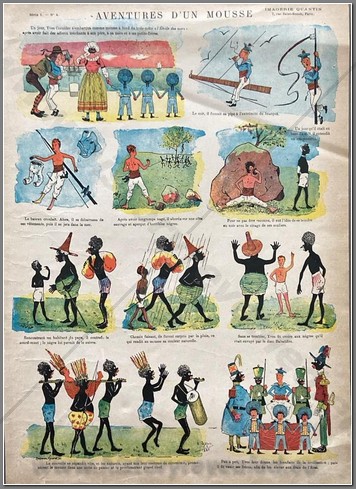
Late 19th/early 20th century Pellerin print by Imagerie D’Epinal. Titled Aventures D’un Mousse, it is about a French sailor named Yves, who falls off his ship and ends up in Africa. He paints himself black to blend in with the locals. When it rains his paint washes off and he is revered by the locals. The last frame reads “Little by little, Yves gave them the benefits of civilization; then he brought his brothers over, in order to raise them at the expense of the state.” SOLD
Price: $100.00
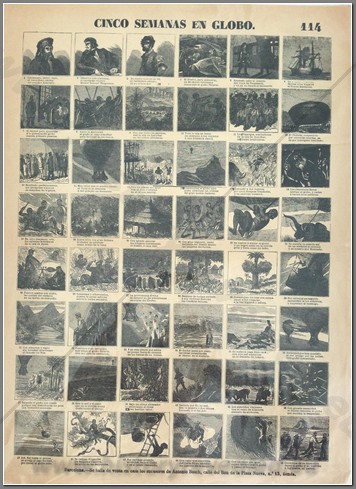
NOTE: The Imagerie d'Épinal ( Vosges ) was originally a printing house founded in 1796 by Jean-Charles Pellerin and where the first images of Épinal were engraved in series. Initially a craft, Epinal imagery gradually became a real industry. The imagery initially used an image engraved in a wooden block ( xylography ). The sheet was then printed using a hand press, called a " Gutenberg ". Then the colorist intervened: using stencils, he applied the different colors necessary to finish the work with a round brush. Around 1850 , the appearance of lithography offered greater possibilities to the artist. Nevertheless, the images of Épinal still represented only 2% of the volume of images peddled in 1860. From 1829 to 1845, the imagery celebrated the Emperor Napoleon Bonaparte, his family, his marshals, his armies and his victories. Under the influence of Rousseauist thought, mid- nineteenth - century society began to see children as consumers. Riddles, dolls to assemble, and soldiers entered the catalog of imagery. At the dawn of the 20th century, the production of imagery was known throughout the world. Puppets, paper theatres, constructions and then, during the First World War , military subjects were all areas where dissemination was significant.

 AFG 194