Photo Collections

eth496ETH 496

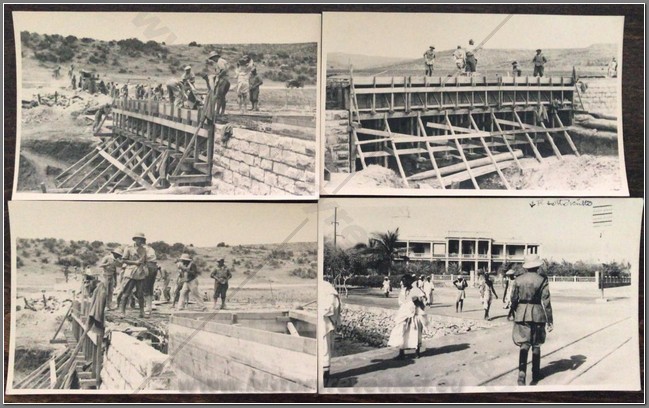
4 photos of Italian bridge construction in Ethiopia during the Occupation.

Price: 100.00

NOTE: Immediate strategic interests, as well as long term economic considerations, necessitated heavy initial investment in road construction. In 1936-7 as many as 60,000 Italian workmen were employed on the roads, though this figure fell by 1939 to 12,000 Italians, assisted by 52,000 “native” labourers. The rudimentary pre-war Ethiopian road network centred on Addis Ababa, was in this way integrated into a more extensive grid based on the Italian colonial ports of Massawa and Mogadishu. The country’s road mileage was thus considerably expanded. Such road-building, though impressive, was achieved at the price of postponing, and seriously curtailing, investment in other, potentially more profitable, fields of economic activity.

eth495ETH 495eth495aETH 495

Beautiful photo album belonging to an Italian aviator Lieutenant Luciano Orlandini fighting in Ethiopia, 1935-1936, with the 3rd Air Brigade, 14th Bomber Squadron. He flew a Caproni Ca.101, which was used as both a transport and a bomber. On the inside cover he writes “The now legendary expertise and fearlessness of Italian aviators guarantee the safety and victory of the Fatherland in the skies”. Shown are his disassembled plane being offloaded at Massaua on December 9, 1935; he is shown frequently with local natives; he poses upon his return from flights to Axum, Asmara,Dessie, Gondar. He is based mainly in Axum throughout the war. He is shown showing off one of his bombs; posing with gold medal recipient Bombonati; numerous photos of Axum showing architecture, daily life, a funeral, showing where the Negus was crowned; military camp at Axum; rare photo of a tankette; named Eritrean ascaris; rare photo of the hanging of one of the “assasins” of the massacre at Mai Lola (Gondrand Massacre); repairing his plane; much fraternization with the local natives; visit by the Duca di Bergamo; spotting Starace’s column from the air’; very nice and very rare photos of the “La Disperata” Squadron, commanded by Mussolini’s son-in-law Count Ciano; extremely rare photo of one of Haile Selassies’ few airplanes, caption reads “the remains of the Potez of the Negus, bombed by our aircraft” (Note: Haile Selassie had only 24 planes in total. 6 of them were the Potez 25 A-2) which was most likely a Red Cross plane eth495a1ETH 495eth495a2ETH 495(see NOTE below); photo him with famed pilot Lieutenant Mendez as well as General Baccara; transporting Marshall Badoglio’s wife!!; photos of Starace; stacking bombs; a destroyed Caproni Ca. 111 light bomber; rare photo of Badoglio with Colonel Baistrocchi; shown with another Medagli d’oro recipient, Agostini; incredible aerial photos of the aerial bombing of Dabat on March 12, 1936; the hanging of the “assasins” involved in the Gondrand massacre; photo of General Liotta, supreme commander of the air force in East Africa; cemetery at Mai Lolo for the victims of the Gondrand Massacre; great views of Amba Alagi; on leave in Asmara; rare photo of tankettes with a plane from 118th Squadron at Addis Abeba; planes airbound to bomb Ras Immru at Gimma in November 1936 (one of the last holdouts, Ras Immru surrendered on December 19; aerial sortie sent to wipe out Ras Desta and the Dejasmatch Gabre Mariam who had assembled military forces in the Great Lakes district; loading bombs at Addis Abeba to hunt down Ras Immru; photo of an actual bomb release over Ras Immru’s camp in December; Addis Abeba military airstrip lined with tankettes and aerial bombs during the campaign to catch Ras Immru; incredible photos of Italian aircraft destroyed by rebels in Addis Abeba almost a full year after the war officially finished; incredible photo of a destroyed airplane of Haile Selassie’s Imperial Guard, with a note on it saying “Comrades the aviators present”; a visit to a remote western region Dembidollo in November; Café Romano in Addis Abeba;eth495a2ETH 495eth495a3ETH 495 Viceroy Graziani in Addis Abeba, December 5, 1936; aboard a train to Dire Daua and Djibouti mid December; voyage home. A remarkable album 426 photos, plus stationary from the Royal Palace and two news articles of pilots shown in the album. The most comprehensive album covering the air war in Ethiopia I have ever seen. It includes the bombing of a Red Cross plane and the hunting down of the villains of the Gondrand Massacre. It covers all major campaigns on the Northern Front and gives good account of chasing down Ras Immru, the last Ras to surrender. SOLD

Price: 5000.00

Note: Reportedly Dabat had a landing field for air travel, and was utilized before and during the conflict with fascist Italy. On 4 December 1935, 12 Italian planes dropped over 150 bombs and struck Ras Imru Haile Selassie's army near the landing field. After an initial battlefield victory, dejazmach Ayalew was ordered to send Italian prisoners under his custody to Addis Abeba by air. The fascists bombed Dabat every two days for a period during the conflict. Dejazmach Ayalew's fortified residence and the town's church (Gebriel) were completely destroyed and burnt by bombs.

eth495a4ETH 495On 2 April 1936, Dabat fell under fascist occupation. The Italians established a large farm, a granary, a small food processing plant, and an agricultural research centre in Dabat. They also opened a post office on 1 December (or 29 November) 1937.

NOTE: From BETWEEN BOMBS AND GOOD INTENTIONS The Red Cross and the Italo-Ethiopian War, 1935–1936, by Rainer Baudendistel…..” Assuming that the pilots could not see the Red Cross signs, Junod and von Rosen rushed to the airfield with the intention of removing the branches so that the emblems would be exposed. Before they managed to get there, a second wave of five Ca.111 in two patrols arrived at about 10 a.m. and attacked the two targets on the ground. The leader of the second patrol, flight lieutenant Luciano Orlandini, claimed in his flight report that he had destroyed Haile Selassie’s Potez, too, as Vedovato before him, but Junod’s and von Rosen’s accounts attribute its destruction unequivocally to the first wave of attacking planes. More important for the subject of this study was, however, Orlandini’s discovery. When he had completed the bombing over….”

eth495a6ETH 495 eth495a7ETH 495 eth495a8ETH 495 eth495a9ETH 495

eth494ETH 494

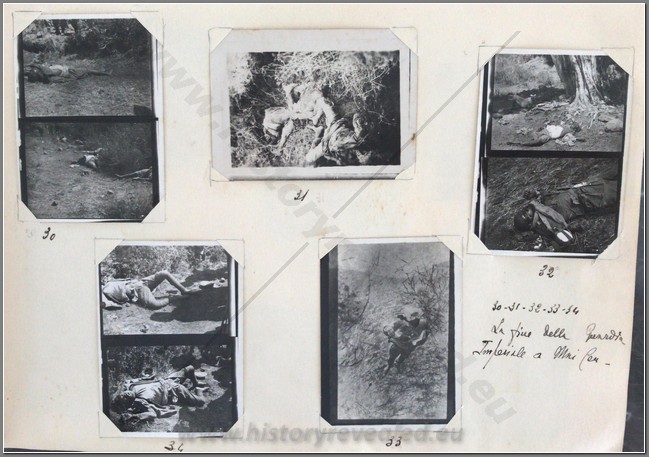
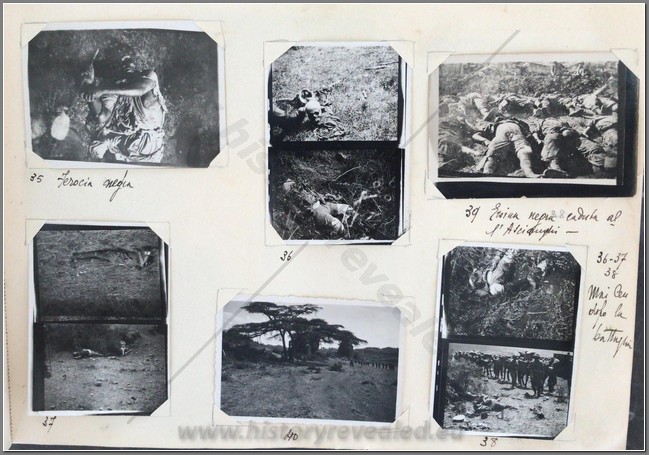
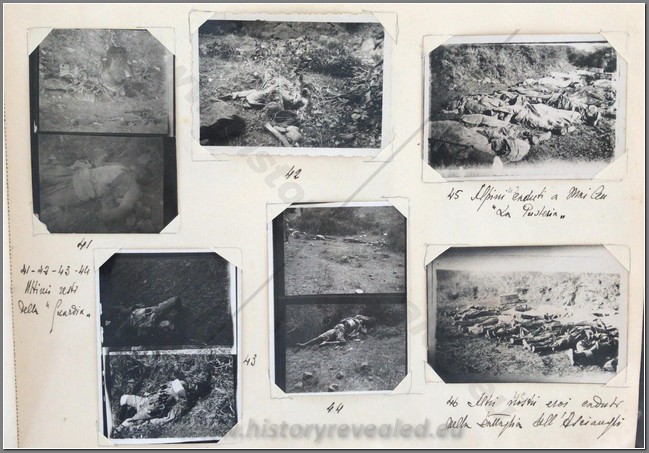
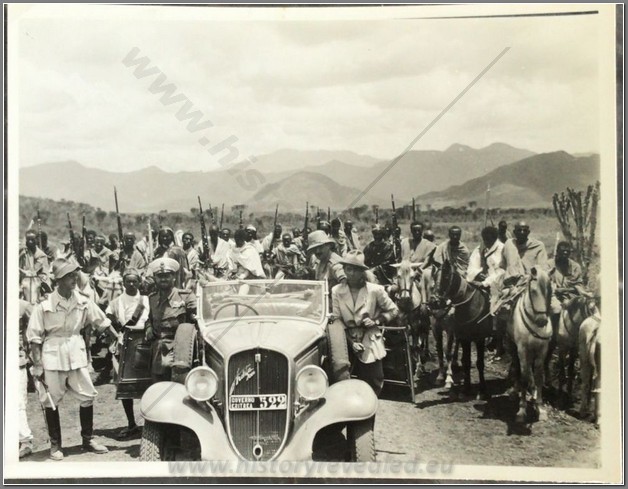
Photo album belonging to an Italian officer fighting in Ethiopia in 1936. Most remarkable are the photos of dead Ethiopians in the field following the battle of Mai Cheu, March 31, 1936. Shown are the Italians hauling heavy artillery, prisoners of Haile Selassie’s Guard, Catholic Mass before battle, Badoglio with Ras Gugsa, rare photo of an Italian tankette, dead Imperial Guard, victorious Italians celebrating, General (commander of the 26th Infantry Division "Assietta") at Adi Calo, transporting a bande after the battle, executing a rebel. May photos of indigenous people and Italians as well. 100 photos in all, most captioned.

Price: 1500.00

NOTE: The Battle of Maychew (Italian: Mai Ceu) was the last major battle fought on the northern front during the Second Italo-Abyssinian War. The battle consisted of a failed counterattack by the Ethiopian forces under Emperor Haile Selassie making frontal assaults against prepared Italian defensive positions under the command of Marshal Pietro Badoglio. The battle was fought near Maychew (Mai Ceu), Ethiopia, in the modern region of Tigray.eth494aETH 494 At dawn on 31 March 1936, the attack was launched. The Italians had been "standing to" in the front line positions all night, alerted to the attack by an Ethiopian deserter. The mountain troops (Alpini) of the 5th Alpine Division "Pusteria" were dug in on the slopes of Amba Bokora for the Italian I Corps. The rest of the I Corps was in reserve, the 26th Infantry Division "Assietta", the 30th Infantry Division "Sabauda", and the 4th CC.NN. Division "3 Gennaio". The two Eritrean divisions of the Eritrean Corps held Mekan Pass, the 1st Eritrean Division and the 2nd Eritrean Division. The 1st CC.NN. Division "23 Marzo" was in reserve for the Eritrean Corps. The Ethiopians advanced in three columns of 3,000 men each. In the first attacks, the Ethiopians hurled themselves at the Italian positions in waves. The fury of the attack and surprisingly accurate mortar fire carried the Ethiopians well into the defensive lines of the "Pusteria" Division. But the mountain troops struck back and soon the front lines were stabilized. The Ethiopians switched the focus of their attack and 15,000 men under Ras Kassa advanced against the Eritreans holding Mekan Pass on the Italian left flank. Haile Selassie hoped to face less resistance from the Eritreans. From 0700 to 0800 hours, the Ethiopians kept up a steady onslaught and, despite taking heavy casualties, were beginning to make gains. But at 0800 Badoglio unleashed the bombers of the Italian Royal Air Force (Regia Aeronautica) and the Ethiopians could hear the ominous engine roar as they closed in with poison gas. Haile Selassie now played his trump card. The Imperial Guard, under the command of Ras Getachew Abate, was sent in against the Eritreans. The training and discipline of this elite force was apparent in the methodical mode of their advance over the open ground. For three hours they struggled to roll up the Italian flank. eth494a1ETH 494The X Battalion of the 2nd Eritrean Division was virtually annihilated. In the end, the Italian commander of the unit called down concentrated artillery fire onto his own overrun positions and saved the day. By 1600 hours, it was apparent that the Imperial Guard was not going to be able to capture their objectives and Haile Selassie played his last card. He ordered an attack along the entire front. This last desperate action was again made by three columns, it was made under a heavily overcast sky, and it was made with little chance of success. The Ethiopians attacked everywhere and were driven back. It was at this point that the Azebu Galla, who had been on the sidelines, made their allegiance clear and attacked the withdrawing Ethiopians. Haile Selassie's order to retreat was to be late in coming. He placed Ras Getachew Abate as Asmach. But the Ethiopians had lost many front-line commanders, the soldiers had not eaten since before dawn, and discipline had understandably broken down. To make matters even worse, as the Ethiopians fled from the battlefield, they were mercilessly bombed from above by the Italian Royal Air Force and harassed on the ground by the Azebu Galla.

eth493ETH 493eth493aETH 493

Photo archive belonging to Michele Zelede. Best known as a pioneer in French motor car race…….bettter known as “the Abyssinian”. The archive contains 26 large format original photos of various Ethiopian nobility and senior colonial officials, taken in 1911(including one of the chefs of the Imperial Palace, which included a European). As Zelede had been taken to France by famed explorer Henri d’Orleans in 1896, photos may have been inherited by Zelede from his benefactor. There are also photos of Zelede when he was the chauffer of the Marquis Jules-Albert de Dion (1856-1946), pioneer car manufacturer and pioneer in the field of motor racing. In 1883, he founded the De Dion-Bouton company in Puteaux with his partner Georges Bouton. Included is a letter from a chauffer friend of his, asking for a job. It reads: “My dear Zelele. Since the death of Mr. Melin, I have been without work I would like to ask you if you could not have me recommended dby the Marquis de Dion Bouton to Prince Victor Napoleon, 39 Avenue Puine, Brussels, who does not need one nevertheless. The prince, having bought 2 cars from Dion and the Marquis knows him very well I have a good chance of succeeding. Mr. Baron de Zuylen cannot take me back having too many staff at his place. Also, I am completely discouraged to find nothing to do, no way to place me I am really very disappointed at the moment. I hope my dear Zelele, that you will provide me with the requested service. And you know that you can have confidence in me. Compliments receive my best regards. Ch De Roeck”. SOLD

Price: $1500.00

eth493a1ETH 493eth493a2ETH 493Note: from Les Champions dits “de couleur” entre mythes et realites, by Yvan Gestaut: “….Often referred to as "Abyssinian," Zélélé is therefore a unique case in the annals of the early days of sport. On the one hand, he is an intruder in an expensive and largely worldly sport, ruling out almost any possibility of practicing outside of the elite. On the other hand, his career is not that of a deserving athlete who would have earned his place through the strength of his talent and physical prowess. Certainly, Michel Zélélé does not lack talent, and he will prove it behind the wheel with some fine, though rare, performances. Moreover, it was first of all through domesticity combined with the goodwill and strategy of his "master" that we find him at the forefront of the sporting scene in the mid-1900s. Zélélé was in fact the chauffeur of the Marquis Jules-Albert de Dion (1856-1946), one of the great figures of modernity at the end of the 19th century, a car manufacturer and, in doing so, a pioneer in the field of motor racing. In 1883, he founded the De Dion-Bouton company in Puteaux with his partner Georges Bouton. In its sector, the company was one of the most important in the world before 1914. Jules-Albert de Dion was himself a glorious sportsman: a driver in the first major competitions such as the Paris-Rouen or the Paris-Bordeaux-Paris, before co-founding the Automobile Club de France (ACF) and the Aéro-Club de France in 1895. He was also an all-round entrepreneur who created the Motor Show in 1898, contributed to the launch of the newspaper L'Auto-Vélo in 1900 (which would become the major sports daily L'Auto ) without ever ceasing to promote his automobiles in numerous competitions, half-sporting, half-society. It was therefore he who, ultimately, made Zélélé famous. According to Zélélé himself, who testified to Michel Carrière in 1951, he was the son of a great Ethiopian chief, born on June 15, 1885, in Ofcat. He was "brought" to France in 1896 by the explorer Henri d'Orléans, who had traveled through this region several times and met Menelik II, the Negus (Emperor of Ethiopia) between 1889 and 1913.”

eth485ETH 485


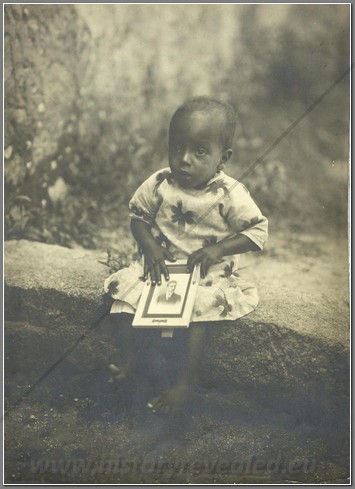
1920’s photo of an Eritrean child holding a portrait of an Italian benefactor.

Price: $50.00

eth484ETH 484eth484aETH 484


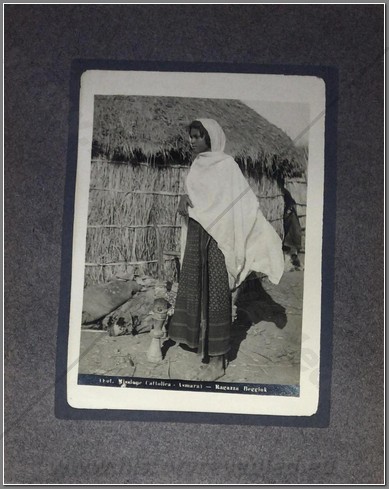
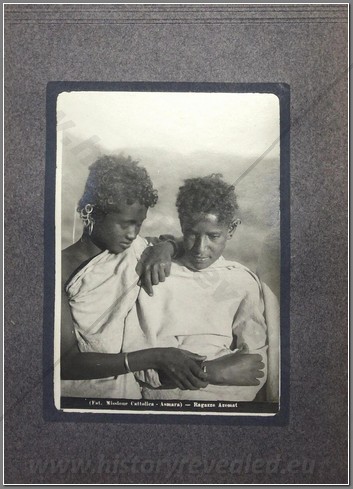
1920’ photo album by the Missione Cattolica in Asmara of different Eritrean types.

Price: $500.00

eth474ETH 474


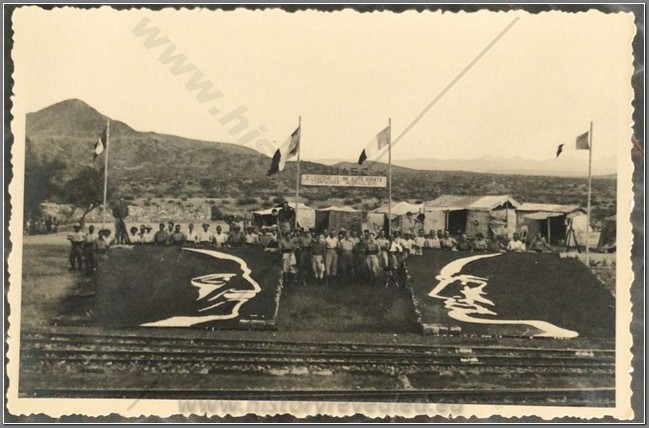
Rare photo of the camp of 2nd Legion CCNN Autocarrata.

Price: $50.00

eth473ETH 473


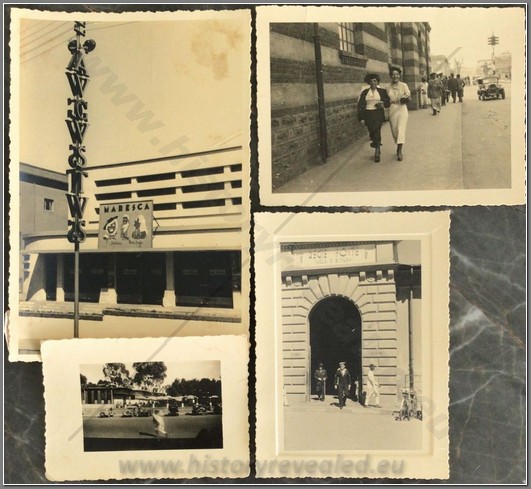
4 photos of colonial life in Asmara in the 1930’s.

Price: $150.00

eth472ETH 472


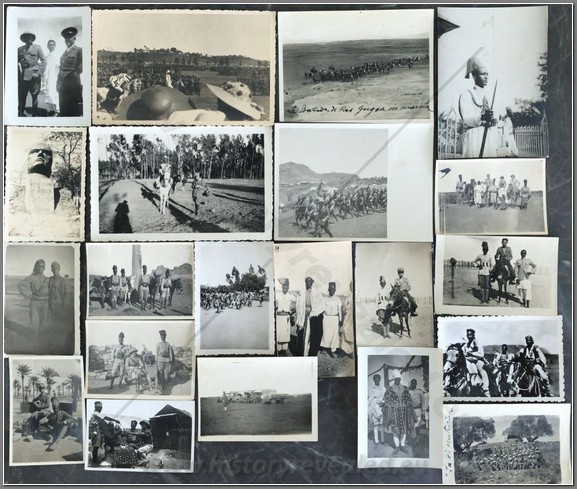
Collection of 21 photos of Eritrean ascaris, as well as Ras Gugsa and his bande. Some with unusual uniforms. 

Price: $1000.00

eth471ETH 471


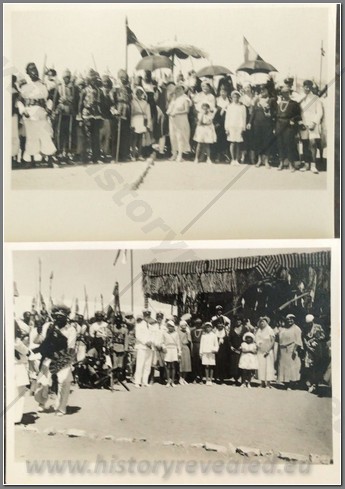
Two early 1920’s photos of Italian notables and their families with Eritrean notables.

Price: $70.00

Copyright © 2013-2024 History Revealed