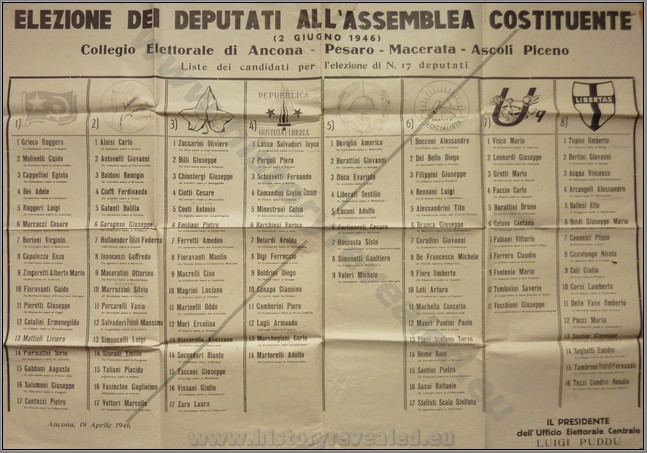
 EPM 096
Large poster for the 1946, first post-war election in Italy. This is for Ancona and lists all the candidates for each of the parties. Size: 84x119cm. M
Price: $450.00

EPM 096
Large poster for the 1946, first post-war election in Italy. This is for Ancona and lists all the candidates for each of the parties. Size: 84x119cm. M
Price: $450.00
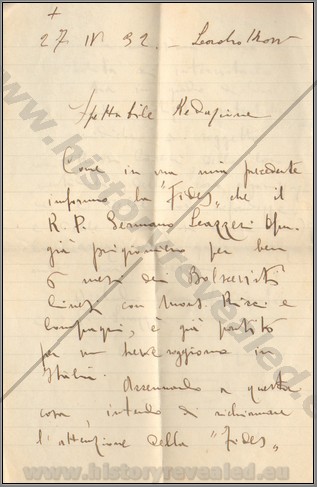 EPM 093
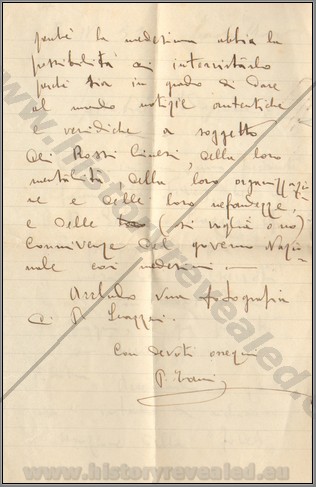 EPM 093
An interesting letter written in 1932 by an Italian who was a prisoner in Russia for 6 months, as he was a White Communist. He talks about another prisoner, Monseigneur Ricci who was freed and “basks” in Italy. He talks about the Chinese communists and complains that the Italian government knows what is going on but does nothing. M
Price: $90.00
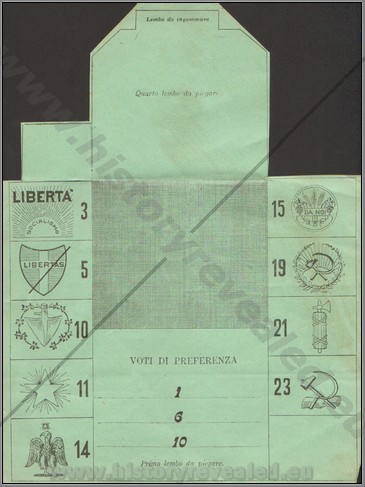 EPM 089
Original 1921 facsimile ballot produced by the Libertas Party that was intended to educate people that they should put their mark beside the Libertas Party. This was the last free election in Italy. Scarce. MM
Price: $190.00
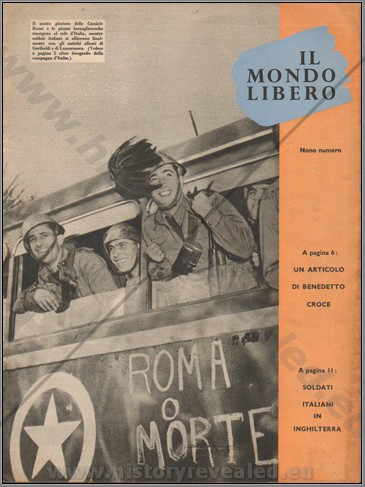
Four issues of Il Mondo Libero, published by the Anglo-American Services. These issues were not dated but these are issues 9, 10, 11 and 13 and are from 1943 as Italy is still at war but the Allies have landed in Sicily. Full of anti-Axis and pro-Allied content. This was a short-lived magazine and hard to find. Listed in Worldcat but no library holds this. M
Price: $390.00
 EPM 071 EPM 071 | 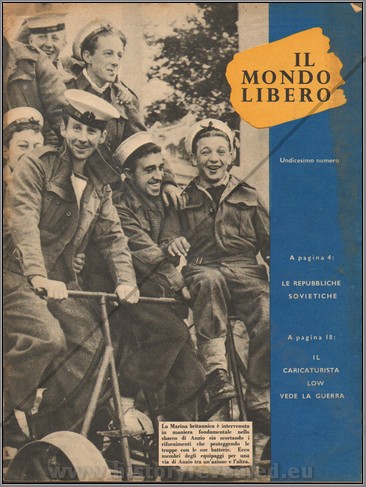 EPM 071 EPM 071 | 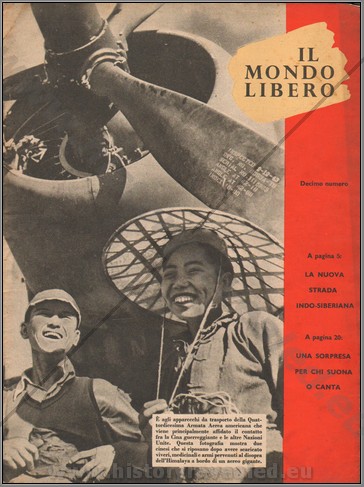 EPM 071 EPM 071 | 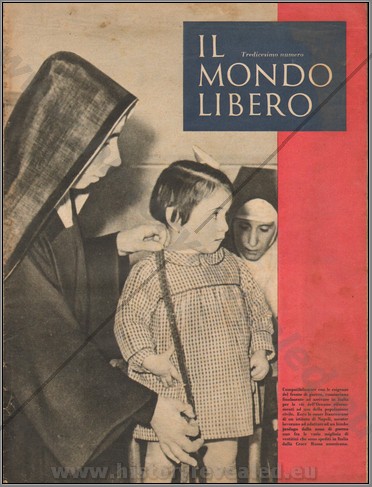 EPM 071 EPM 071 |
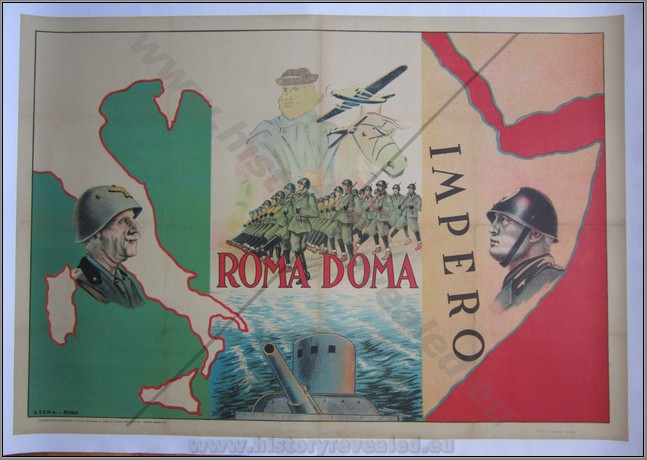 IEA-P-EPH 210
Large poster ROM DOM IMPERO authorized by the Ministero Cultura Popolare, 1938. Cloth backed. Size: 75 x 105 cm. M
Price: $1200.00
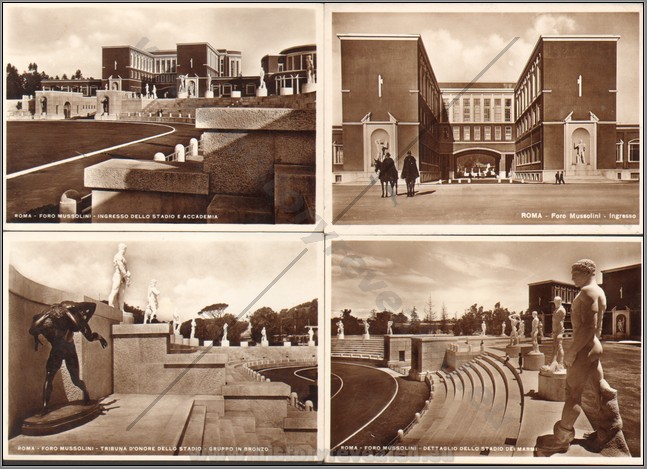 EPM 062
Four photo postcards of Foro Mussolini in Rome. M
Price: $120.00
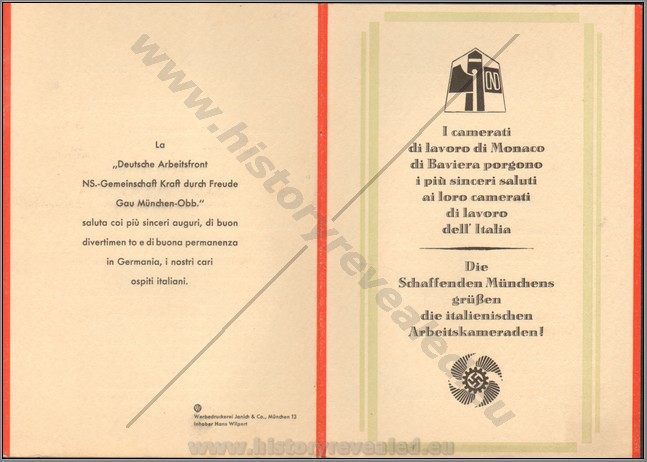 EPM 060
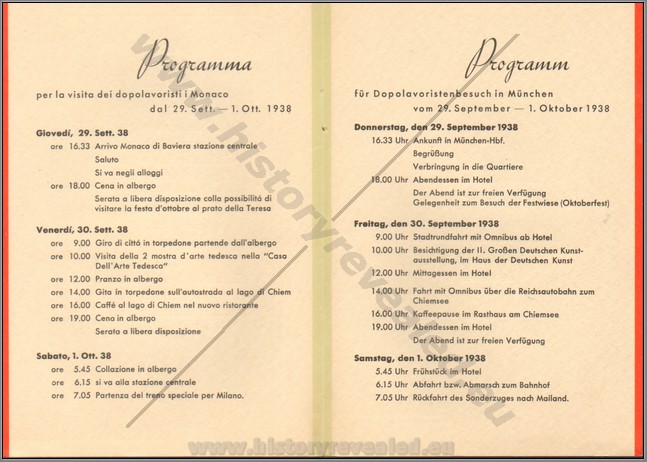 EPM 060
Program for a German-Italian meeting in Munich during Octoberfest, September 29 to October 1, 1938. The Geman Labor Front was hosting workers from Milan. Also during that exact same weekend, not more than a few kilometres was away, the Munich Conference between Hitler and Chamberlain was taking place
Price: $90.00
 EPM 054
 EPM 054
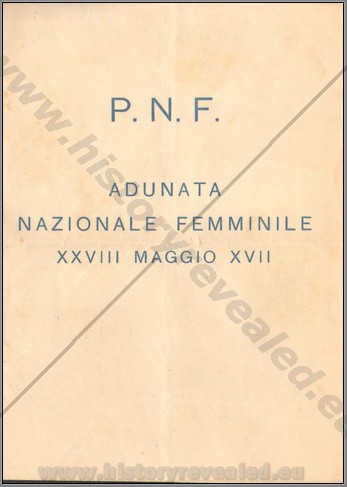
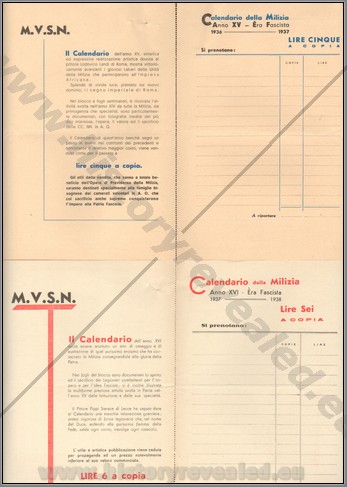
Program for the meeting of Fascist Women, May 28, 1939. ASK FOR AVAILABILITY
NOTE: On May 28, 1939, the P.N.F. held a massive military-style rally in Rome where 70,000 women marched past Mussolini to celebrate the regime's focus on motherhood, imperial expansion, and domestic duty. Under Italian fascism, women were strictly valued as mothers, homemakers, and reproducers who would build the population for the regime's military and colonial goals. While they were pushed to stay at home, the P.N.F. also heavily organized them into party groups. The women's wing of the party was called the Fasci Femminili (FF). It was founded in 1919 and by 1939 had nearly 750,000 members. It was divided into several sub-groups to reach different parts of society: Massaie Rurali: Focused on rural and peasant women; Sezione Operaie e Lavoranti a Domicilio (SOLD): Organized factory and domestic workers; ONMI: A welfare organization that provided support for mothers and children. The May 28 rally in Rome was one of the largest propaganda events of its kind. 70,000 women from across Italy gathered in the capital to be reviewed by Mussolini. It was designed to show total support for the party's imperial goals and the "Fascist Revolution". Women marched in massed formations wearing specific uniforms. Some sections, such as young women going to the colonies, even carried rifles with fixed bayonets to show they were ready to defend the nation.
Price: $120.00
 EPM 052
 EPM 052
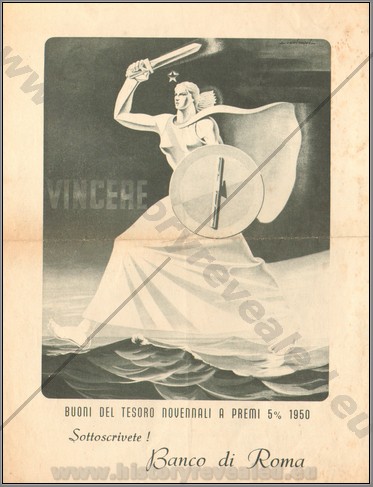
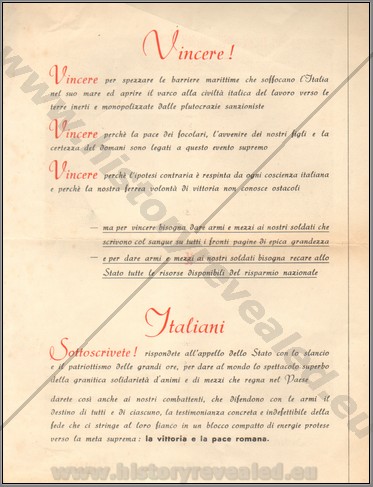
Advertising for a new bond issue from the Banco di Roma, maturing in 1950. M
Price: $100.00
 EPM 051
1940 advertisement for a magazine Il Tricolore. In the 1920s and 1930s, there was a weekly newspaper/magazine titled Il Tricolore: giornale dei giovani fascisti (The Tricolour: Newspaper of the Young Fascists). It acted as an action and propaganda publication geared toward youth and the general public, and ran until the summer of 1943.
Price: $70.00
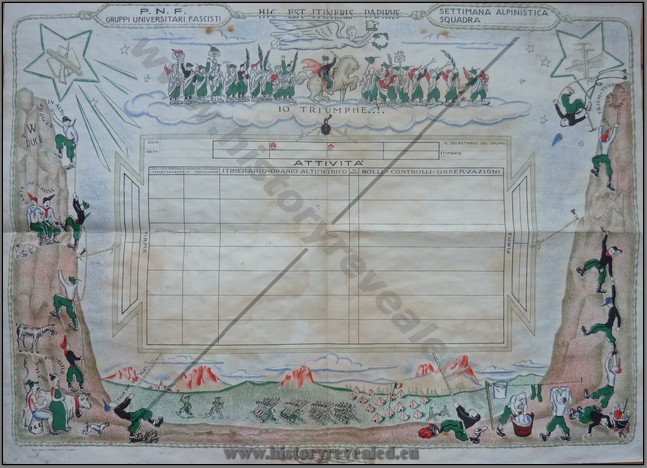 EPM 029
Original diploma from an Italian fascist university, published in Milan. Wonderful motifs. Size: 48 x 67. m
Price: $600.00
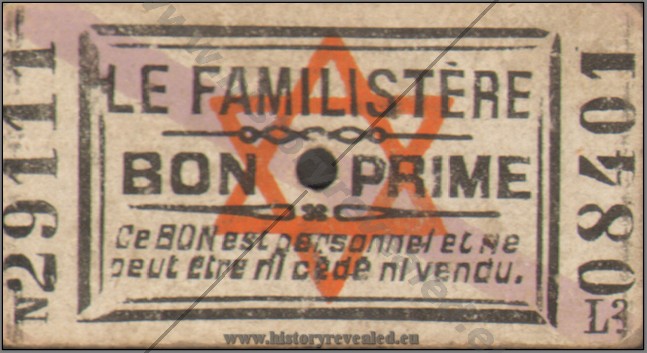 EPM 021
Rare numbered non-transferrable worker bonus voucher given to workers resident at Le Familistere to be used for store credit or dividends. Has the “Seal of Solomon” stamped on it.
Price: $90.00
Note: "Familistère" is the name given by Jean-Baptiste André Godin (1817-1888) to apartment buildings he built for his workers and their families, from 1858 until 1883. He was a French industrialist, writer and political theorist, and social innovator. He built an industrial and residential community within Guise called the Familistère (Social Palace) from 1856-1859. He ultimately converted it to cooperative ownership and management by workers. His intention was to improve housing for workers, but also "production, trade, supply, education, and recreation", all the facets of life of a modern worker. He developed the Familistère as a self-contained community within the town, where he could encourage "social sympathy". The full site with the foundry was about eighteen acres, on either side of the River Oise. In addition to a large factory for cast-iron manufacture, three large buildings, each four stories high, were constructed to house all the workers and their families, with each family having apartments of two or three rooms. The main building consisted of three rectangular blocks joined at the corners. Each of these blocks had a large central court covered with a glass roof under which children could play in all weather. Galleries around the courtyard provided access to the apartments on each floor. There were also garden allotments for the workers. By 1872, 900 workers (including women) and their families were housed there, for a total population of about 1200. In 1880 Godin created the association documents for the Familistère, converting it as he had long intended into a co-operative society, eventually to be owned by the workers. It was called l'Association coopérative du Capital et du Travail.
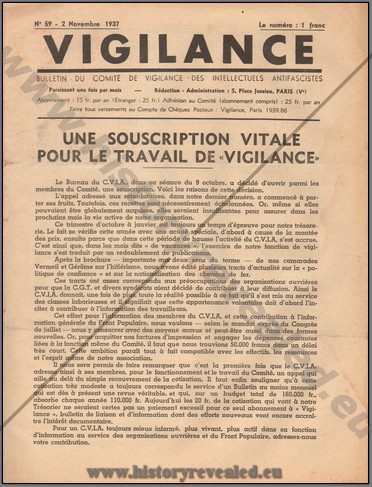 EPM 019
 EPM 019
Three French communist bulletins on the developments in the Spanish Civil War. 28 pages in total. Lots of detail from the point of view of the French Left Wing. M
Price: $270.00
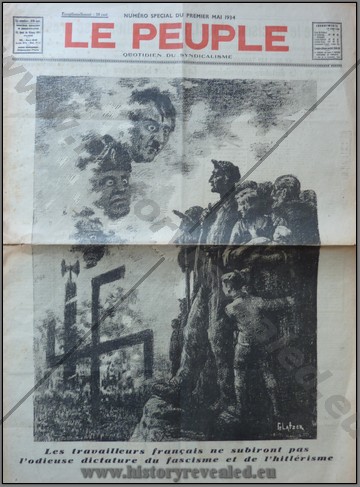 EPM 018
Special edition of Le Peuple, May 1, 1934. Cover reads “The French workers will not suffer the odious dictatorship of Fascism and Hitlerism”. Fold splits at margins.
NOTE: "Le Peuple" was the official daily newspaper of the French General Confederation of Labour (CGT), acting as a voice for the trade union and labor movement. A highly anticipated issue was published on May 1, 1934. This specific edition hit the stands during a highly volatile time in French history. Coming just months after the violent far-right riots in Paris on February 6, 1934, the nation was heavily polarized and facing economic hardship
Price: $190.00
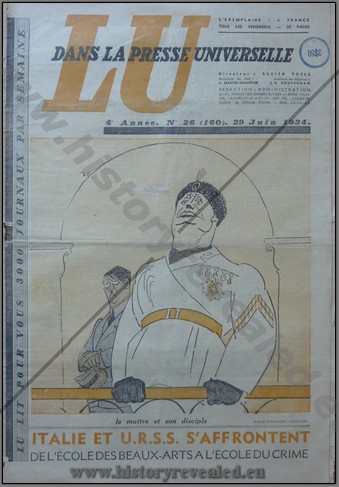 EPM 017
Complete issue of LU Dans la Presse Universelle for June 29, 1934. This was aFrench weekly magazine published between 1931 and 1937. Based on the principle of the international press review, this journal offered translations and summaries of articles from newspapers around the world. Cover features Hitler and Mussolini with the caption Le Maitre et son Disciple ("the Master and the Disciple"). Not surprising as it deals with the first meeting between Hitler and Mussolini, as well as French diplomacy in the Balkans. These press analyses appear on the eve of the "Night of the Long Knives" in Germany, which will dominate the news the very next day. In the USA only Stanford holds this title
Price: $90.00
 EPM 016
 EPM 016
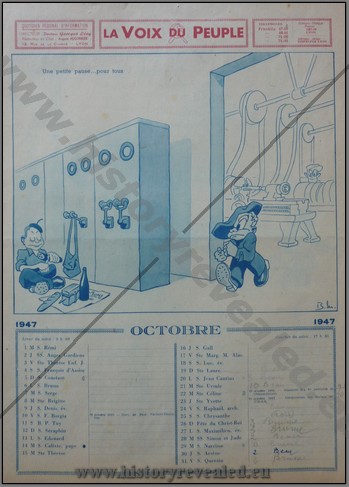
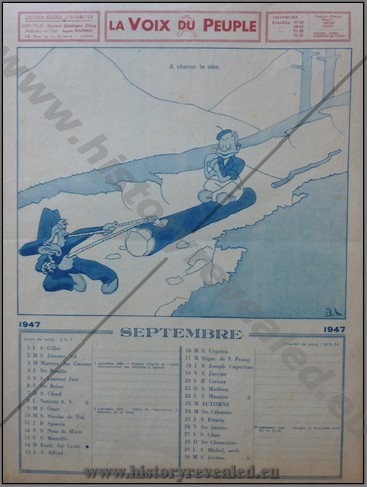
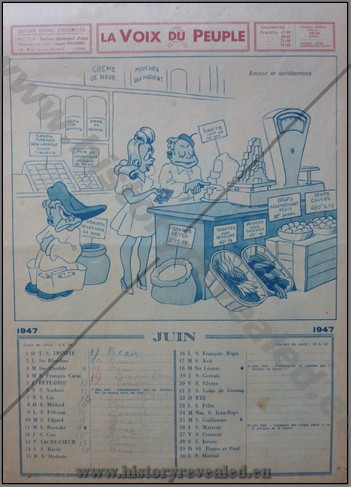
French Communist Party humorous calendar for 1947 titled La Voix du Peuple.
NOTE: The 1947 humorous calendar titled La Voix du Peuple was a popular propaganda almanac published by regional federations of the French Communist Party (PCF). The PCF published these satirical calendars to reach working-class households. They functioned as both decorative wall hangings and educational tools. The Key Features of the 1947 Almanac are 1)Political Satire: The calendars poked fun at conservative politicians and capitalist interests, while praising party leaders like Maurice Thorez; 2) Socialist Triumphs: They celebrated the recent victories of the French labor movement and the creation of the welfare state, which communist ministers helped establish before leaving government later that year; 3) Cultural Content: Alongside political slogans, these items contained practical household tips, short humorous stories, recipes, and caricatures; 4) Daily Reminders: The calendar highlighted important international dates and historical events relevant to the international labor and communist movements.
Today, these vintage calendars serve as significant historical artifacts. They offer a look into how the PCF used visual propaganda, folklore, and humor to spread its message and connect with everyday citizens at the dawn of the Cold War.
Price: $150.00
 EPM 016 EPM 016 | 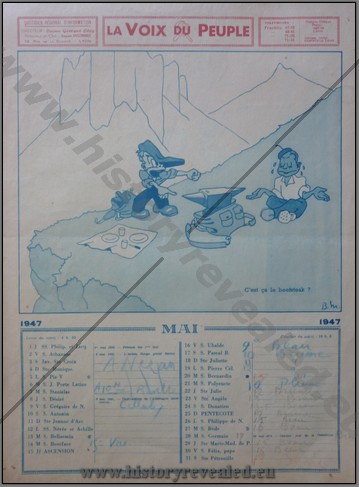 EPM 016 EPM 016 | 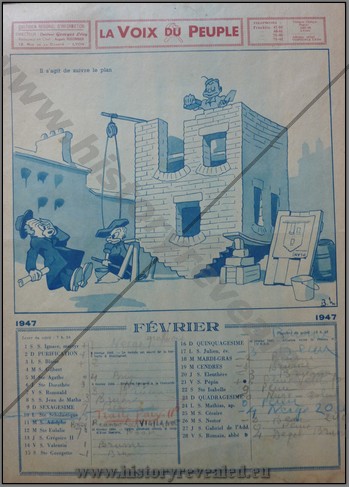 EPM 016 EPM 016 | 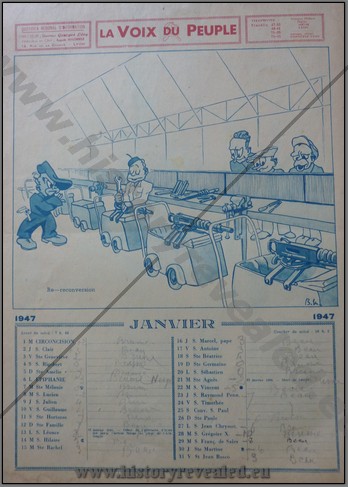 EPM 016 EPM 016 |
 EPM 014
 EPM 014
 EPM 014
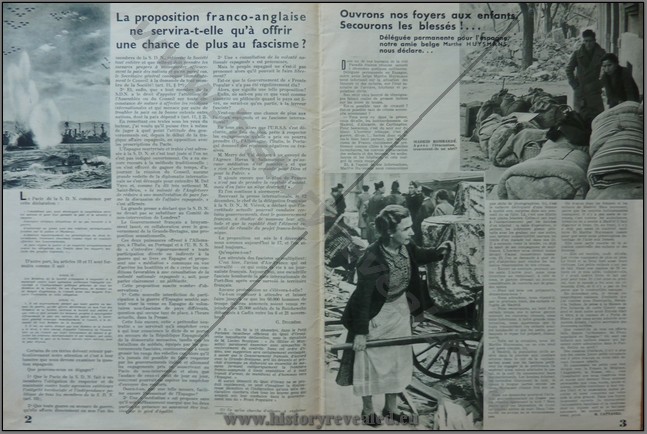
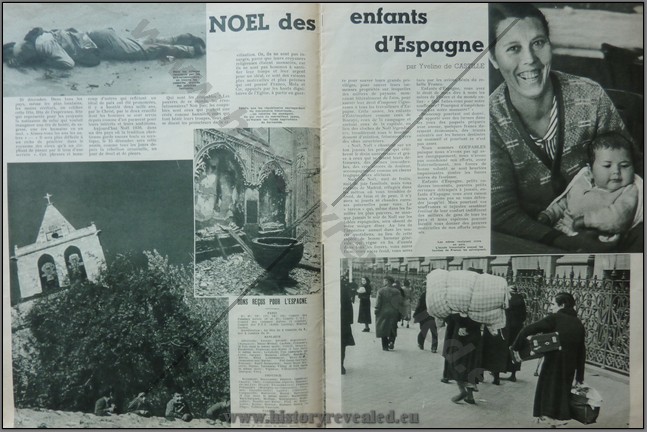
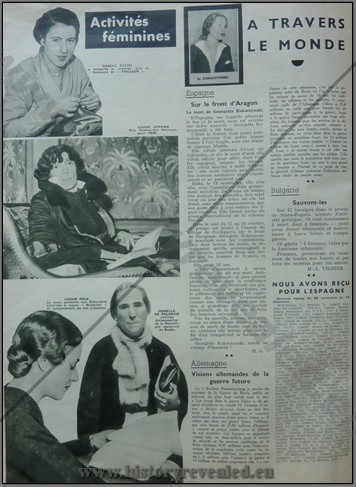
French Communist periodical Femmes. December 1936. Mostly on the Spanish Civil War. m
Price: $120.00
 EPM 013
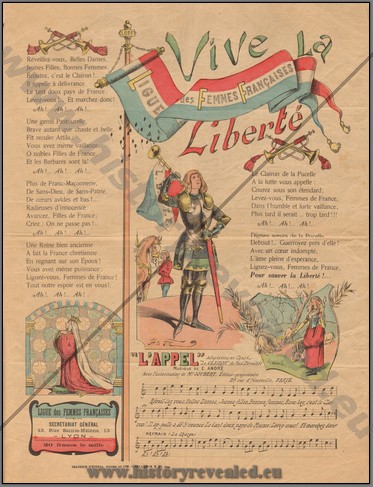
EPM013. 1902 Poster by the newly formed Ligue des Femmes. This poster is titled Long live freedom, League of French Women. "The Call" is an adaptation to the song "The Bugle" by Paul Deroulede (1846-1914). The designer of the poster was Henri de Sta (1846-1920). Size 30x39cm. $290
NOTE: The Ligue des Femmes Françaises (French Women's League) was a large, conservative, and fiercely Catholic women's political organization in France, which existed from 1901 to 1933. The league was founded in September 1901 in Lyon by Jeanne Lestra and Countess Octavie Thomas de Saint-Laurent, with guidance from the Jesuit priest Antonin Eymieu. The organization was created as a direct resistance to the aggressive anti-clerical policies of the French government (the Bloc des gauches) and the 1901 Law on Associations, which sought to restrict religious congregations. Because women did not have the right to vote in France at the time, the founders realized that the only way to influence politics was to mobilize the vast number of pious Catholic women. They aimed to 1) Influence elections: Campaign for and fund political candidates who supported the Church and religious freedom; 2) Defend Catholicism: Fight the secularization of French society and defend traditional family values and 3) Encourage female political action: Prove that women could be a powerful force in the public and political spheres, despite being disenfranchised.
In 1902, a separate Parisian faction split off to form the Ligue Patriotique des Françaises (LPDF). The two groups became rivals. The original Lyon group (LFF) was strongly monarchist and fiercely independent, while the Paris group (LPDF) had a more republican, conservative focus. Despite their ideological differences, both leagues shared the common goals of defending the Catholic Church and promoting social welfare. In 1933, under direct pressure from the Vatican and the Church hierarchy, the two rival leagues merged to form a unified organization: the Ligue Féminine d'Action Catholique Française.
Price: $290.00
 EPM 006
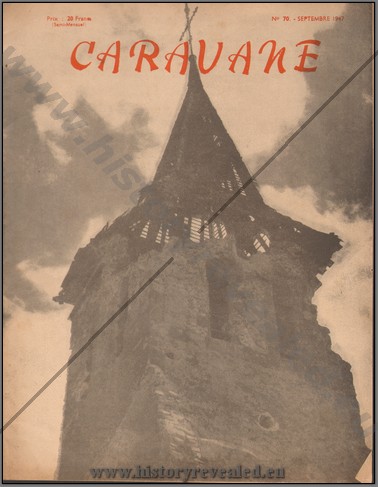 EPM 006
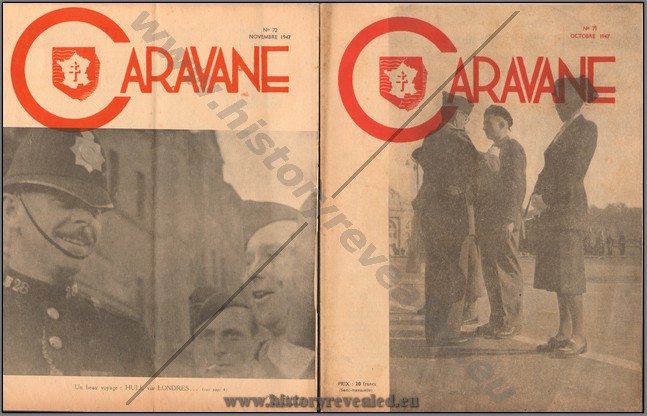
3 issues of Caravane, September-December, 1947. This was a magazine published on the initiative of General Leclerc for the veterans of the 2nd Armored Division. No USA library holds this.
NOTE: The magazine was launched in October 1944 on the initiative of General Philippe Leclerc de Hauteclocque as a bulletin to maintain connections, share stories, and chronicle the journey of his famous division. Post-war, it became the official voice of the Association des Anciens de la 2ème DB (Association of 2e DB Veterans). These 1947 editions primarily focus on post-war veteran life, memorials, division history, and national ceremonies. The issues during this period are highly historically significant, as they capture the immediate aftermath of the war and the shocking loss of their commanding general. Following Leclerc's death in late November, the December and January issues served as tributes, featuring extensive coverage of his national funeral, where all the veterans of the 2e DB marched one final time to honor their commander
Price: $270.00
 EPM 004
1903 French patriotic postcard showing the unity of France and Italy. m
Price: $30.00