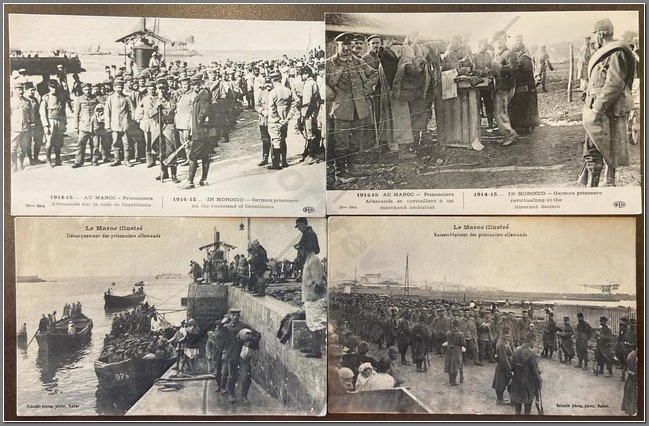
 MR 319
4 postcards of WW1 German POW’s in Morocco.
Price: $120.00

MR 319
4 postcards of WW1 German POW’s in Morocco.
Price: $120.00
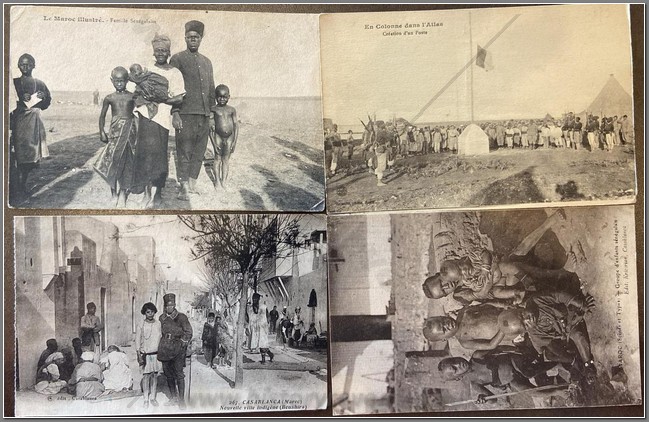 MR 318
4 colonial postcards of Senegalese trailleurs and their families, in Morocco.
Price: $120.00
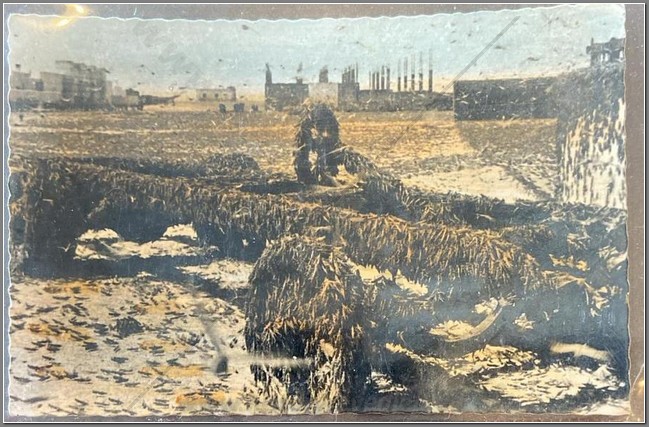 MR 317
Rare postcard of Spanish Sahara, showing a plague of locusts.
Price: $30.00
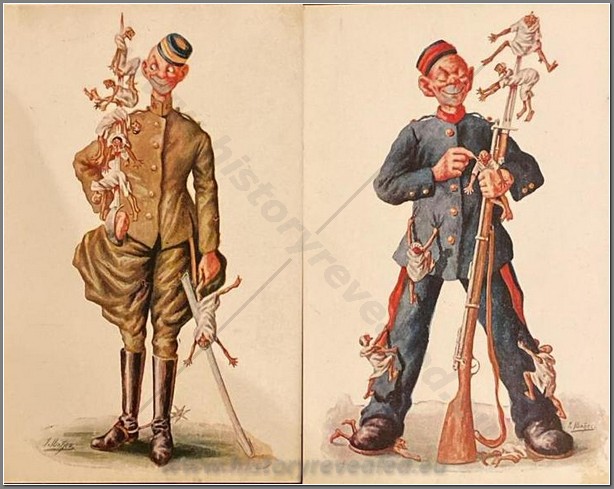 MR 313
2 colonial humor postcards showing the Spanish disdain for Moroccan rebels. Artwork by Ibanez. ANKH
Price: $120.00
 MR 311
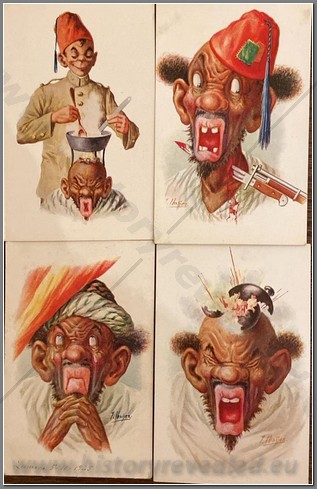
4 colonial humor postcards showing the Spanish disdain for Moroccan rebels. Artwork by Ibanez. AHKH
Price: $240.00
 MR 308
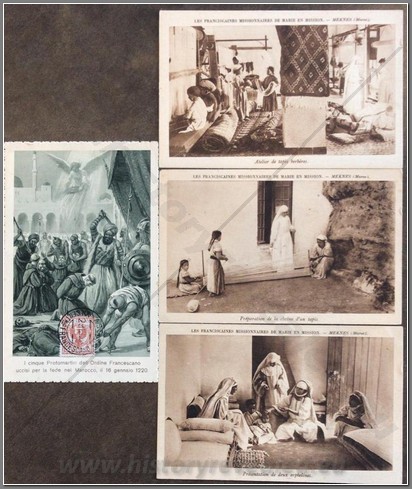
4 colonial postcards on the civilizing mission of the Franciscaines Missionaire de Marie en Mission in Morocco.
Price: $120.00
 MR 307
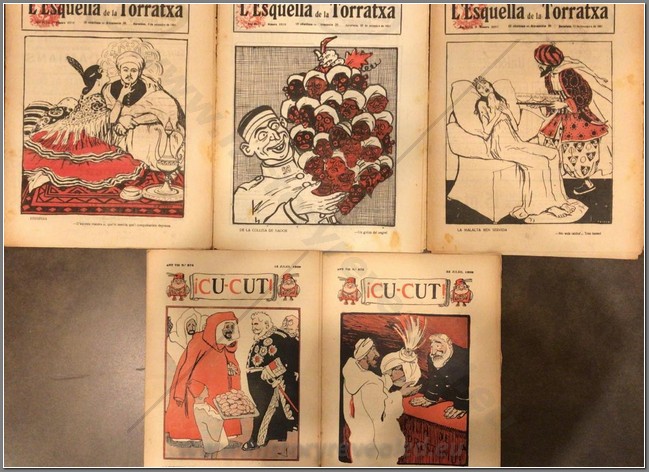
5 Spanish periodicals with the Moroccan wars of 1909 and 1921 dominating the cover.
Price: $200.00
 MR 306
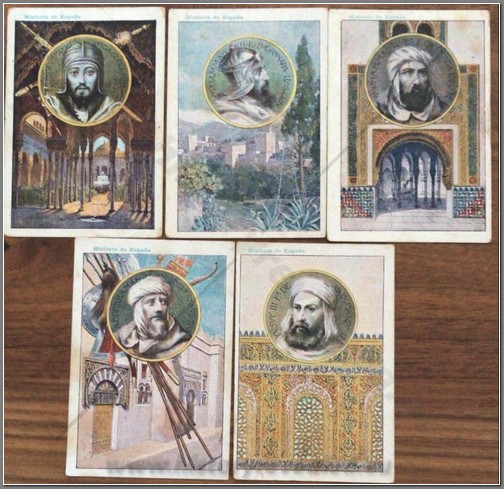
5 early Spanish chromos featuring arab rulers of Spain.
Price: $100.00
 MR 305
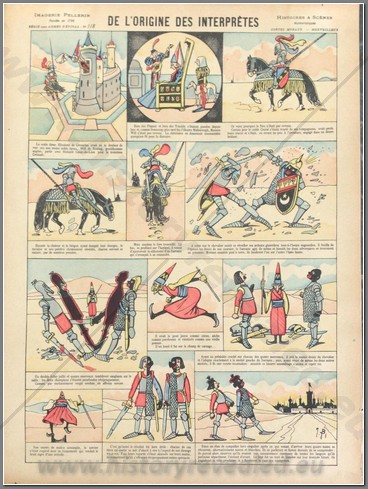
Late 19th/early 20th century Pellerin print by Imagerie D’Epinal. Titled De L’Origine des Interpretes. It features a Moroccan Sarasin.
Price: $70.00
Note: The Imagerie d'Épinal ( Vosges ) was originally a printing house founded in 1796 by Jean-Charles Pellerin and where the first images of Épinal were engraved in series. Initially a craft, Epinal imagery gradually became a real industry. The imagery initially used an image engraved in a wooden block ( xylography ). The sheet was then printed using a hand press, called a " Gutenberg ". Then the colorist intervened: using stencils, he applied the different colors necessary to finish the work with a round brush. Around 1850 , the appearance of lithography offered greater possibilities to the artist. Nevertheless, the images of Épinal still represented only 2% of the volume of images peddled in 1860. From 1829 to 1845, the imagery celebrated the Emperor Napoleon Bonaparte, his family, his marshals, his armies and his victories. Under the influence of Rousseauist thought, mid- nineteenth - century society began to see children as consumers. Riddles, dolls to assemble, and soldiers entered the catalog of imagery. At the dawn of the 20th century, the production of imagery was known throughout the world. Puppets, paper theatres, constructions and then, during the First World War , military subjects were all areas where dissemination was significant.
 MR 304
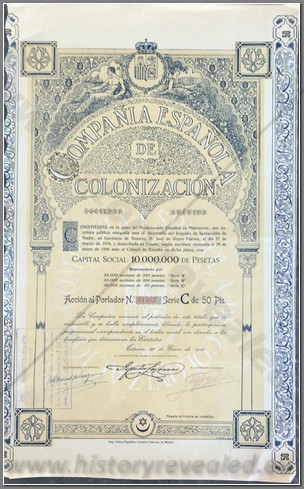
1916 stock certificate for Compania Espanola de Colonization. Uncirculated. SOLD
Price: $90.00
 MR 302
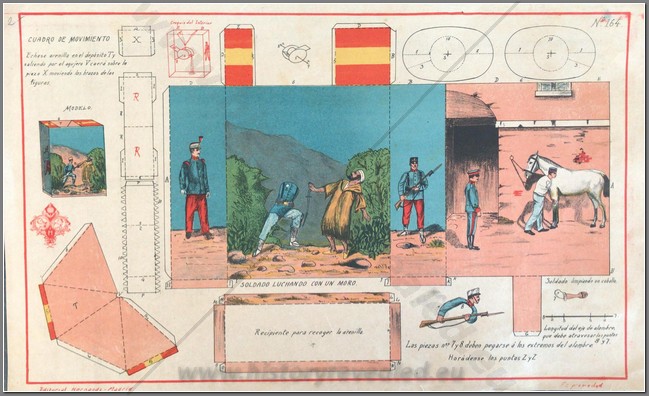
Spanish childrens cut-out of the Second Melillan War (1909-1910).
Price: $350.00
 MR 301
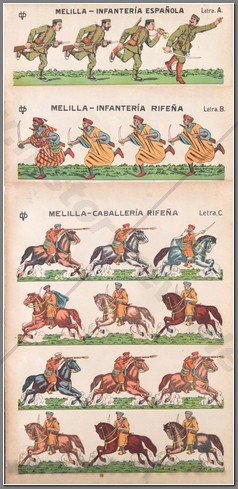
Three Spanish childrens cut-out of the Second Melillan War (1909-1910).
Price: $600.00