Morocco

t-mr080MR 080

Collection of French and English illustrations regarding German interest in Morocco. Full of satire. The cartoon by left wing L’Assiette au Beurre is especially clever. The illustration show the Germans in Morocco, with the caption reading “I am enthusiastic and afraid. Perhaps I am in Tanger”. It is a play on words to rhyme with “danger”. B eh

                                                                                                          Price: $150.00

Note: The First Moroccan Crisis (also known as the Tangier Crisis) was an international crisis between March 1905 and May 1906 over the status of Morocco. The crisis worsened German relations with both France and the United Kingdom, and helped enhance the new Anglo-French Entente.t-mr080aMR 080

On March 31, 1905, Kaiser William II of Germany landed at Tangier and conferred with representatives of Sultan Abdelaziz. The Kaiser declared he had come to support the sovereignty of the Sultan—a statement which amounted to a provocative challenge to French influence in Morocco. The Sultan subsequently rejected a set of French-proposed governmental reforms and issued invitations to major world powers to a conference which would advise him on necessary reforms. Germany sought a multilateral conference where the French could be called to account before other European powers. The French foreign minister, Théophile Delcassé, took a defiant line, holding that there was no need for such a conference. Count Bernhard von Bülow, the German Chancellor, threatened war over the issue. The crisis peaked in mid-June. The French cancelled all military leave (June 15) and Germany threatened to sign a defensive alliance with the Sultan (June 22).t-mr080bMR 080 French Premier Maurice Rouvier refused to risk war with Germany over the issue. Delcassé resigned, as the French government would no longer support his policy. On July 1, France agreed to attend the conference.

The crisis continued to the eve of the conference at Algeciras, with Germany calling up reserve units (December 30) and France moving troops to the German border (January 3). The Algeciras Conference was called to settle the dispute, lasting from January 16 to April 7, 1906. Of the 13 nations present, the German representatives found that their only supporter was Austria-Hungary. A German attempt at compromise was rejected by all but Austria-Hungary. France had firm support from Britain, Russia, Italy, Spain, and the United States. The Germans decided to accept a face-saving compromise agreement on March 31,t-mr080cMR 080 1906 that was signed on May 31, 1906. France agreed to yield control of the Moroccan police, but otherwise retained effective control of Moroccan political and financial affairs. Although the Algeciras Conference temporarily solved the First Moroccan Crisis, it only worsened the tensions between the Triple Alliance and Triple Entente that ultimately led to the First World War. The First Moroccan Crisis also showed that the Entente Cordiale was strong, as Britain had defended France in the crisis. The crisis can be seen as a reason for the Anglo-Russian Entente and the Anglo-Franco-Spanish Pact of Cartagena being signed the following year. Kaiser Wilhelm II was angry at being humiliated and was determined not to back down again, which led to the German involvement in the Second Moroccan Crisis."

t-mr151MR 151


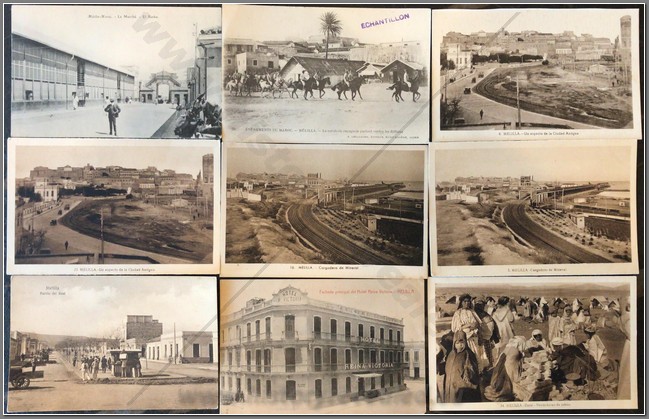
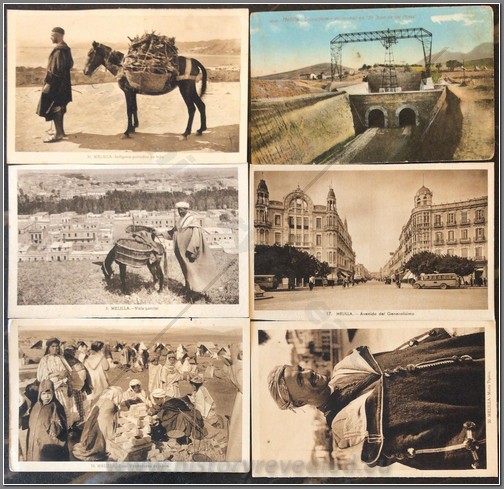
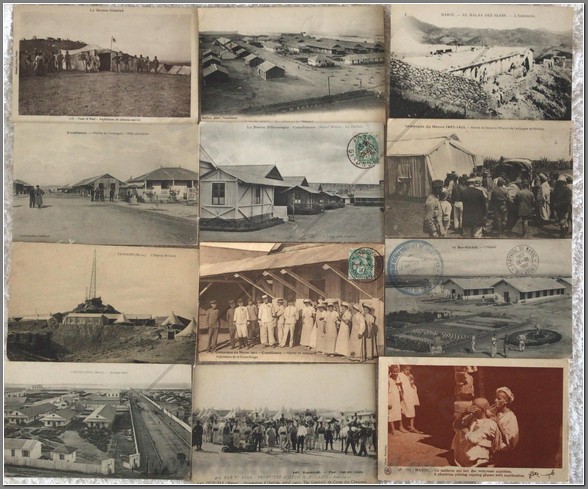
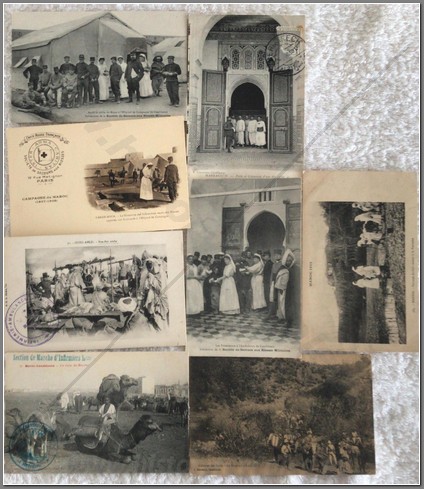
9 colonial postcards of habits, types and architecture of Kenitra. M

Price: $180.00

t-mr151aMR 151 t-mr151a1MR 151 t-mr151a2MR 151

t-mr103MR 103Interesting AUCA titled “Auca del Moro Feixista” or, Auca of the Fascist Moor. Written in Calalan and published by the Comissariat de Propaganda de la Generalitat de Catalunya it is the ficticious story of a Moor named Ben Hamet. He is taken from the Riff War and converted to Chrisitianity. He abandons his muslim belief, eats pork (5), drinks alcohol and smokes (6), abandons Allah (11) and embraces Jehova. He joins the militia (12), learns to be violent (13) and prepares for battle, where he is subsequently wounded (19). He becomes a seminarist. He whip the crowd into a frenzy (29) and tells them to go to the cemetery, where he and others are attacked. The “dirty Moroccan” sees that all is lost (36) so he intentionally feigns madness by shouting but the Reds don’t believe him because he is wearing a cross and the Reds don’t wear crosses (39), so he is sent to prison (40). Thinking he will be executed (41), he looks to escape and finds a small bomb (42). Seeing 3 militiamen playing cards at a table he plans to throw the bomb at them, but unfortunately for him, the bomb explodes in his hand (45). Everyone rushes to see what happened but all that is left of the “blessed” Moroccan is a finger (48)…..and this is how it ends, in pieces, for the criminals Ben Hamets. What is interesting is that Ben Hamet is referred to in the singular up until the last frame, where he is discussed in plural. KH

Price: $700.00

t-mr145MR 145t-mr145aMR 145


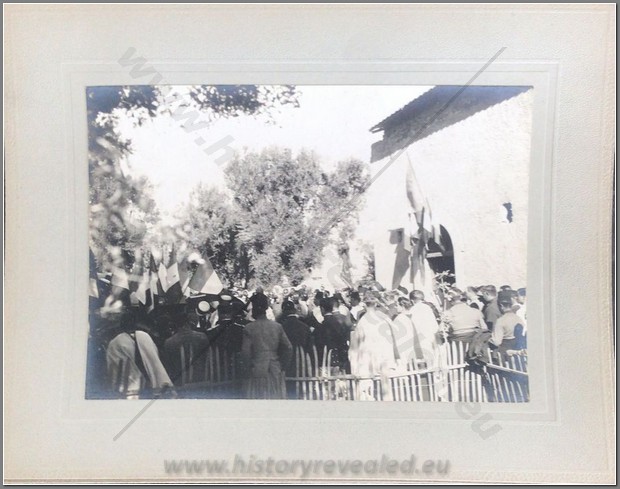
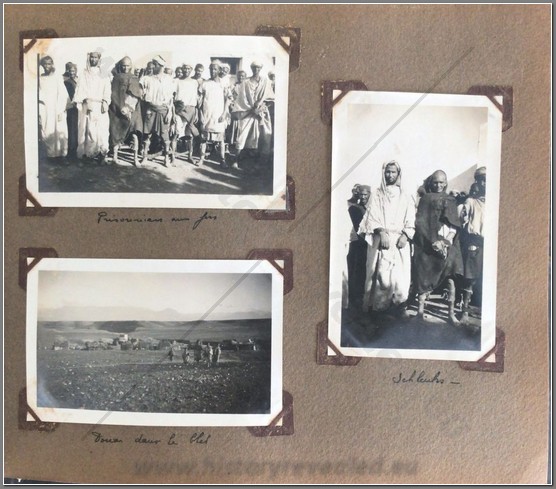
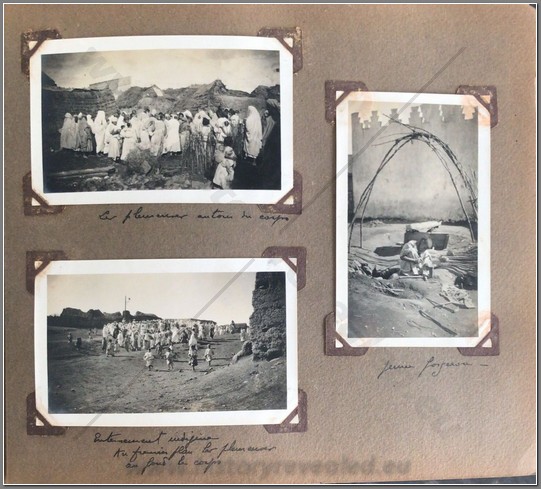
11 photos of a local parade of sorts in Taza in May 1930. There is an attached sheet explaining each photo. m

Price: $290.00

t-mr144MR 144


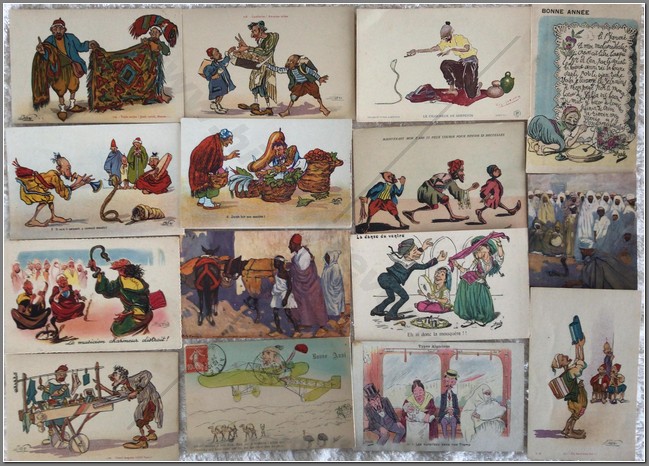
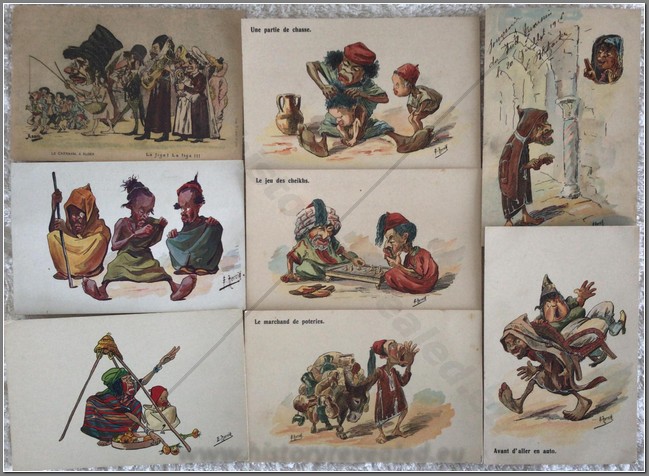
25 Colonial French humor postcards of Moroccans. M

Price: $750.00

t-mr144aMR 144 t-mr144a1MR 144 t-mr144a2MR 144 t-mr144a3MR 144

t-mr137MR 137


Fold out panorama postcard of East Tanger. M

Price: $40.00

t-mr131MR 131


Fold out postcard of Settat during the 1907-1908 war in Morocco. M

Price: $40.00

t-mr130MR 130


Fold out postcard of the July 14 review outside Casablanca during the 1907-1908 war in Morocco. M

Price: $40.00

t-mr052MR 052 t-mr052aMR 052t-mr052bMR 052Rare set of Spanish chocolate cards entitled Historia del Hombre mas Fuerte del Mundo. It is the story of a man named Goliath who has super strength. He ends up in the Spanish Legion and fights in Morocco, where he is captured and subsequently escapes due to his strength. In the end he is awarded a medal. 24 out of 25 cards. Good condition. (ew) KH

Price: $500.00

t-mr126MR 126


French trade card set on life in Morocco. c1900. MBB  en kh

Price: $150.00

t-mr092MR 092t-mr092aMR 092

A collection of 9 illustrations from French and Italian periodicals on the French war in Morocco in the early 20th century. EH B

Price: $360.00

Note: Following Morocco’s first defeat to any European power in 200 years, Morocco gave up Sid Ifni to Spain according to the treaty of Tetouan in 1860.

t-mr092a9MR 092t-mr092a10MR 092Following the Madrid Conference in 1880, Morocco is forced to turn Tangier into a zone of international administration. This came after years of Spanish and French interference in Moroccan politics, generally to the benefit of their own citizens. Morocco had protested against this, but was by now so weak that it had to give up even more than before.

In 1894 Sultan Moulay Hassan died, and his son Abdu l-Aziz was only 10 years of age at the accession. During his reign, Europeans became the main advisors at the court, and local rulers became more and more independent from the sultan’s rule.

In 1904 France reached agreement with Great Britain and Italy on spheres of influence over Africa, leaving Morocco within the control of France. Similar agreeement is reached with Germany the following year.t-mr092a11MR 092

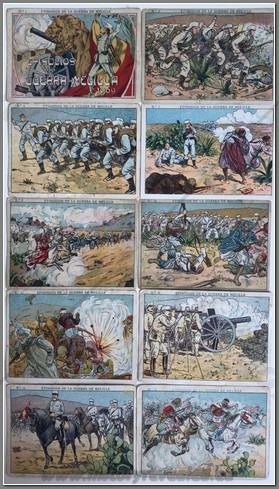
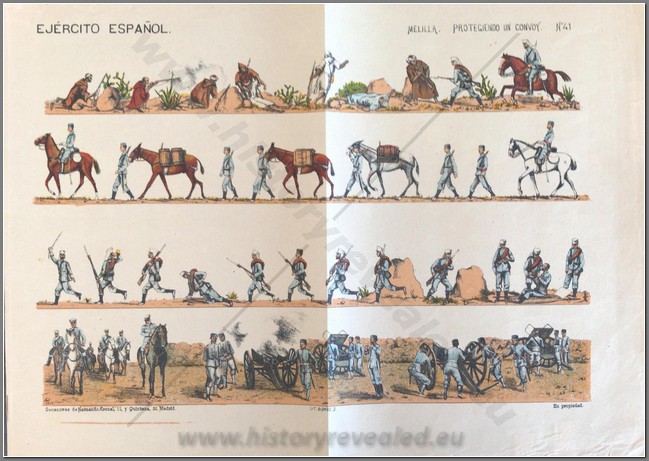
In 1907 France occupied Oujda near the border to French controlled Algeria. Shortly afterward the French invade Casablanca. Spain, worried about its own position, sent 90,000 troops to Melilla, their own enclave in northeastern Morocco.

In 1910 Moulay Hafiz is trapped by the French, and forced to conclude an agreement, which took two years to negotiate. In 1912 the Treaty of Fez is signed. With this, France is given the right to defend Morocco. A similar treaty is signed with Spain, who occupied most of the northern coast, and areas in the deep south.

t-mr092a28MR 092 t-mr092a29MR 092 t-mr092a30MR 092 t-mr092a31MR 092

t-mr091aMR 091


Illustration by Richard Caton Woodville as part of the delegation of Ambassador William Kirby Green to Morocco in 1887. EH B

Price: $20.00

Copyright © 2013-2024 History Revealed