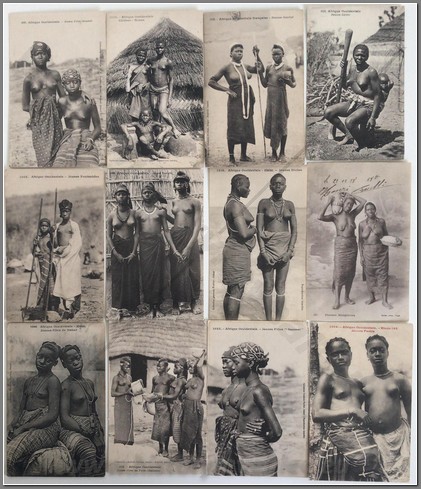
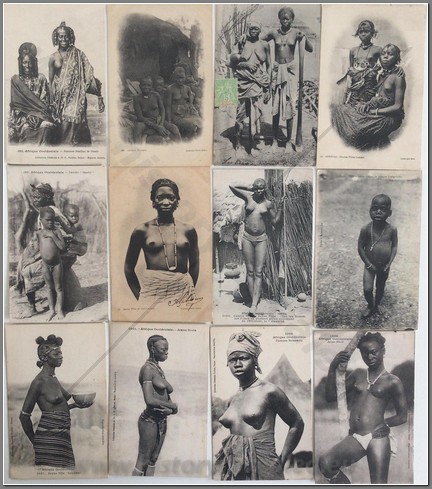
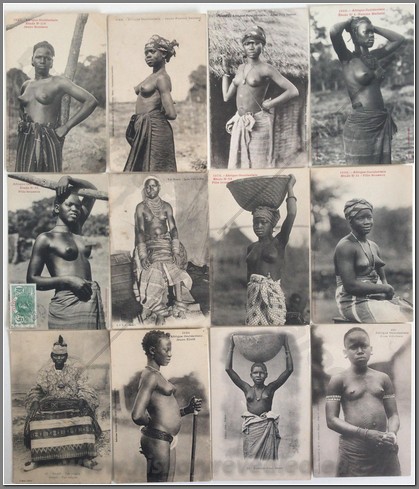
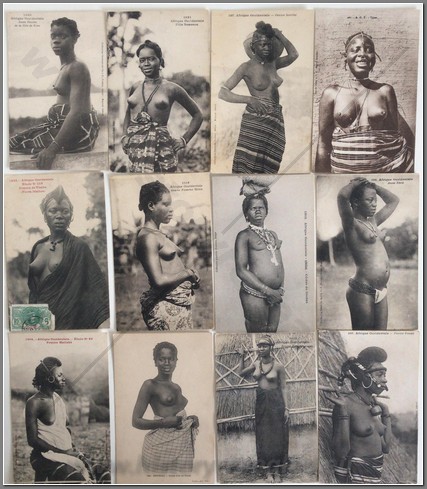
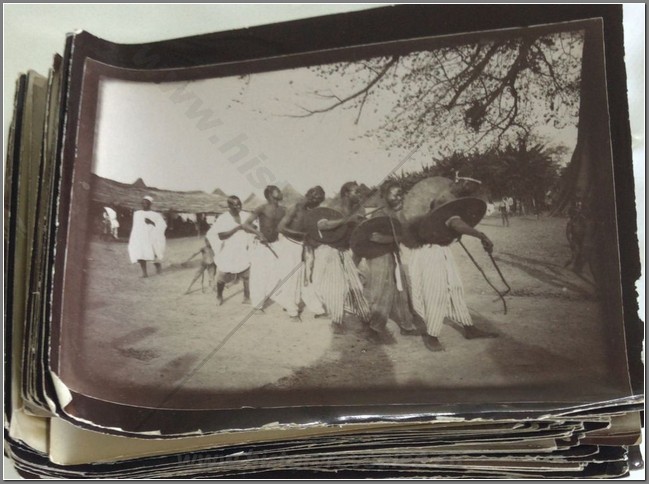
French West Africa
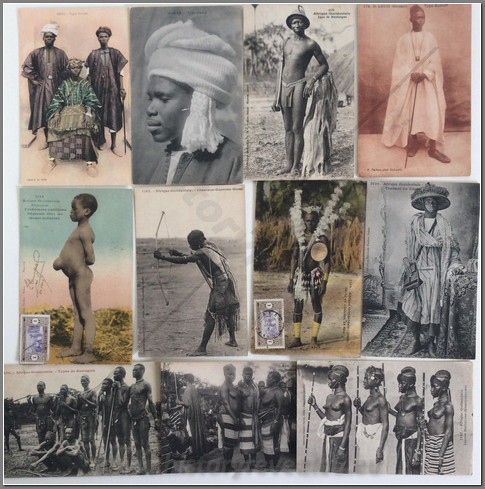
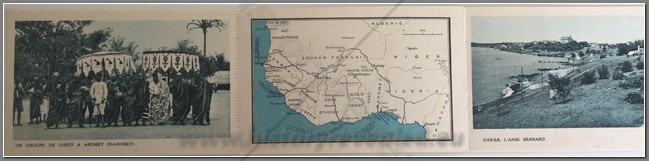
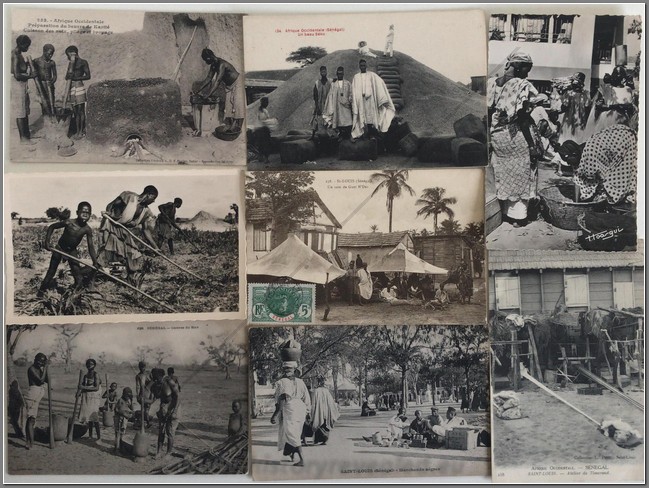
38 colonial postcards of the civilizing mission in Dahomey, mainly by the Society of African Missions. Much is shown on the interaction between the French missionaries and the local population.
Price: $1040.00
NOTE:
FA 419The Society of African Missions (SMA) arrived in Dahomey. SMA priests Francesco Borghero and Francisco Fernandez landed in the port of Ouidah in 1861, establishing the first permanent missions in Dahomey. The missionaries established stations in Whydah and Porto Novo. They also visited the capital, Abomey, but were initially denied permission to evangelize by King Glele. In 1860, the Vatican established the Vicariate Apostolic of Dahomey, which encompassed the territory between the Niger and Volta rivers. In 1882, the ecclesiastical territory was reconfigured, and the Prefecture Apostolic of Dahomey was created.
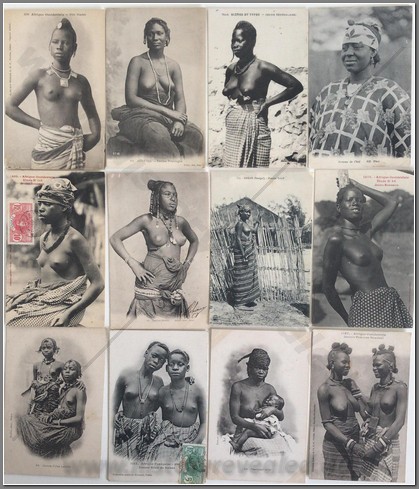
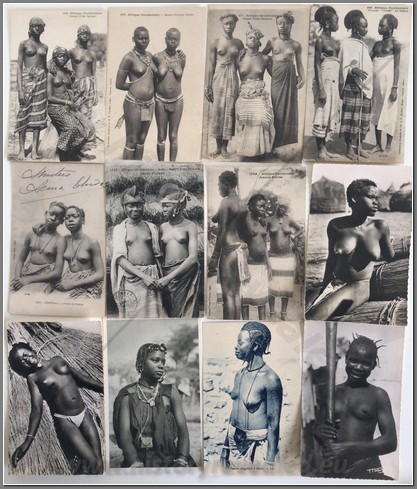
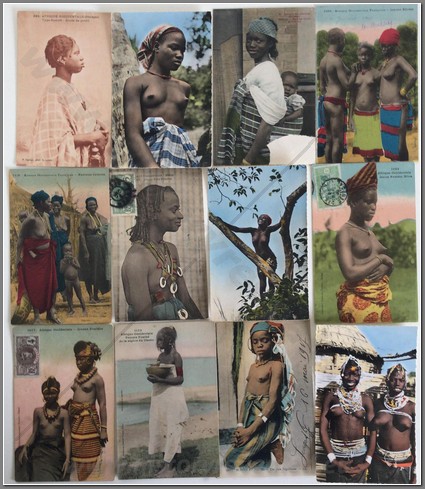
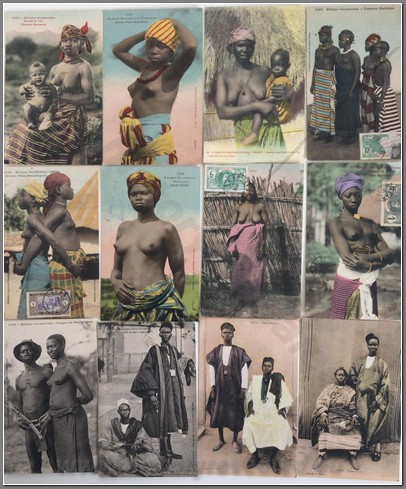
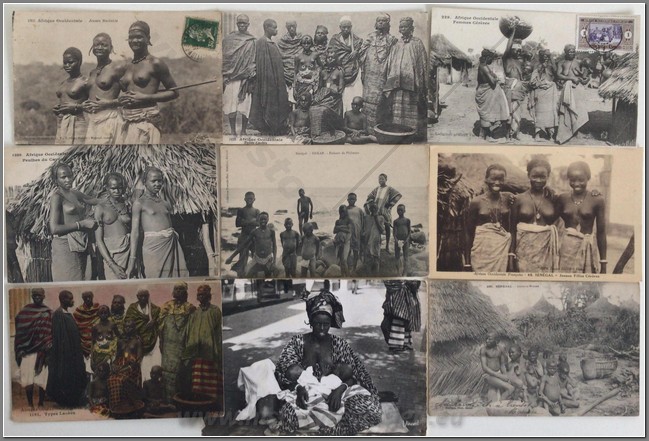
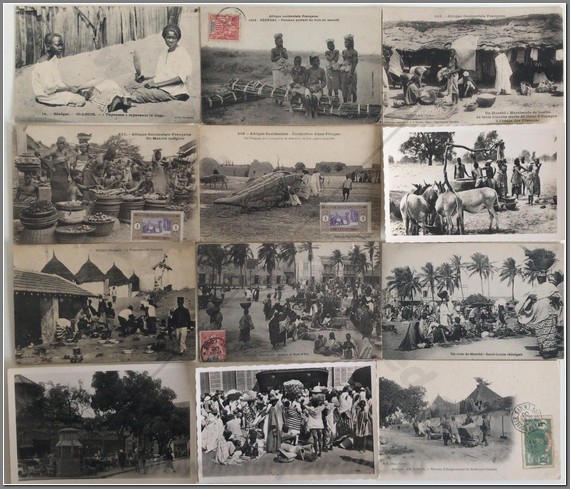
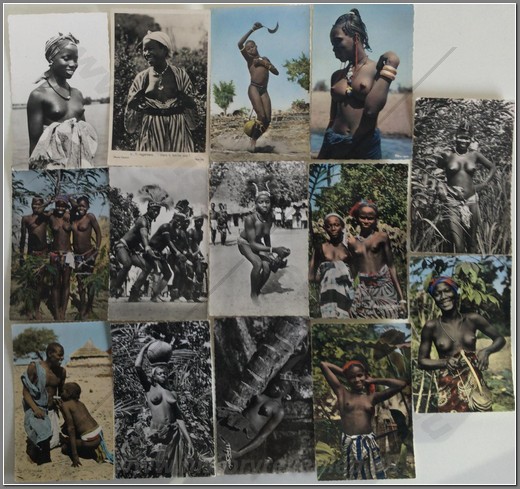
31 colonial postcards of smaller towns in French Soudan, as well as Bamako (capital of future Mali). Shown are Kayes, Medine, San, Segou, Sikasso, Mopti, Kabara, Bandiagara, Tombouctou, Koroyoume, Koulikoro, Ke-Macina. Mostly native life and natives and colonials mixing. Shown are the ruins of Camp Faldherbe, commercial life on the Senegal river, local markets, colonial monuments, colonial gardens, “elegant” Soudanese, catholic mission, port on the Bani River, large muslim procession, native life on the Niger river, paddle steamers, Fort Bonnier, excations outside Tombouctou, a donkey convoy. More.
Price: $930.00
15 colonial postcards of colonial and native life in Haute-Volta. Shown are a European hospital, girls playing, termite mound, villagers going to a party, among the Fulani, local markets, local murals, washing laundry, truck fleet of the S.C.O.A., river crossing, dancers, musicians.
Price: $450.00
Archive from the estate of Monsieur G. Guy, who was a senior French colonial administrator in French West Africa. This collection reflects his tours throughout the region from 1915-1938. Over photos, mostly captioned with many dated. Included is a letter to Guy from famed Africanist Denise Schaeffner, Chargee du Department d’Afrique Noir, Musee de l’Homme, dated Febuary 6, 1950. It says “I am responding to your letter of February 1st requesting information on stone statuettes from the Kissi region (French Guinea).
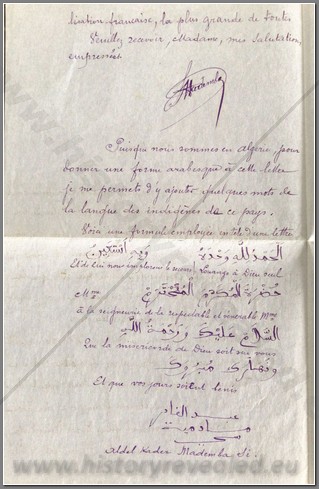
My husband and I made two trips to this region (1945-46; 1948-9), where we collected statuettes that are now at the IFAN center in Conakry and at the IFAN in Dakar. These carved stones are found on ancestral altars, where they are now rarer. The natives claim to discover them while cultivating the land after the rains. Some (the "real" ones, they say) are identified in dreams or by a diviner as the image of a tree; the statuette is then "dressed," that is, wrapped in cotton and consecrated. It now bears the name of the deceased and is used for divination, placed on a stretcher held by two men. The statuette makes sudden movements on the stretcher, which the diviner interprets as reflections on the questions posed. The natives are reluctant to part with their "real" pomdo. We were nevertheless able to bring one back for the Musée de l'Homme.
These statuettes differ considerably. It seems impossible, given our current knowledge, to assign a precise age to each of them. Some can be dated based on costume details, inspired by 16th-century Portuguese armor. They are found in Sierra Leone, where they offer a slightly different, rather grimacing style, and as far away as the coast (Sherbro Islands). A study of the 350 statuettes in the Museum of Mankind was conducted from a mineralogical point of view. Here is the reference: Jeremine E. - Study of Kissian statuettes from a mineralogical and petrographic point of view. Journal of the Soviet of Africanists, XV, 1945, pp. 3-14. I myself intend to publish my observations in a book I am currently working on. Regarding the market value of your objects, it is impossible for me to determine their value without a photograph, of which we would be pleased to have a proof for the Museum's photo library.
Please accept, Sir, the assurance of my highest consideration.
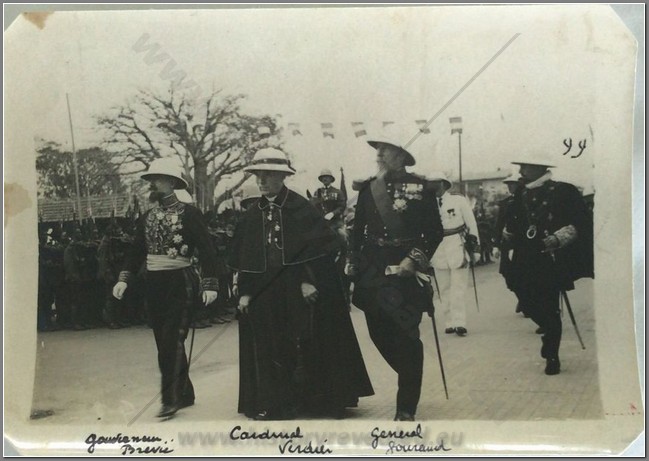
Captioned photos in Guys hand were numbered, and he tabulated each on a separate piece of paper. The archive begins in 1910-1911, where G. Guy is in Tiassale, Ouassau and Abaisso, Ivory Coast. Shown are the local post, tribal chiefs, July 14 celebrations, Guy’s home, local trailleurs, local mosque, military band. 30 photos. Then on to French Guinea from 1914-1916 where he visits Conakry, Faranah and Dabola. Shown are the local railroad, the home of Mr and Mrs. Lauzet and Leireau, a number of French colonialists shown by name, French post, Guy with the chief of Caubou and Dabola, constructing a rail line in Conakry, rail station at Dabola, local troops departing for France at the outbreak of WW1, village life, entry to the post at Dabola, school children, local communion, governor’s palace at Konakry, arrival of Minister Lanault at Dabola. 38 photos. While in Guinea he visits Kissidougo from 1916-1917. Shown are Guy with Governor Poiret addressing local natives, passage of Captain Awabrie, constructing a thatched roof, local dancers, burying a missionary, raising a bell, transporting rice, spinning cotton, locals attending a palabra, allotting rice, Governor Poiret attending a palabra, Guy departing for a journey. 18 photos. He then moves on to Tombouctou, Mali from 1927-1928. Shown are the entry to Tombouctou, paddle steamer on the Niger at Katara, celebrating the arrival of R. Caulle, the grand mosque, camels in military use, bus of the Compagnie Generale Transsaharienne, village outside the walls of Tombouctou, military commanders, local market, la place Joffre, locals doing laundry, July 14 troop review, French administrators debarking by local boat, police station with small market in front, Palace of Justice, Governor’s palace, local oven, Fort Bouvier, military review for Marshall Trauchel d’Eifery, indigenous chiefs visiting, returning camel caravan, distributing gifts to the locals, a visit from the governor of
FA 391French Sudan, native circus, departing for Kabara. 54 photos. He visits Niafunke, Mali in 1930. Shown are a fantastic aerial view of the town (with much detail on the elevation, pilot name, observers name, coordinates and time), local circus, horse racing, July 14th celebrations, local colonial villa, Mr. Guy’s residence, local life, Madam Guy aboard a biplane, traversing the Niger. 16 photos. From 1932-1935 he is in Kaya, Haute Volta. Shown are his local residence, encampment at Boulsa province, Governor Reste, feeding pigeons, colonialists shown by name, local headmen with Pere Delbos, local chapel and congregation, residence in Zaiko, disembarking at Port Bouet, Madame Guy with horse and servants, governor’s daughter being transported by locals, Madame d’Orfaud with child and servant, Governor of Cote d’Ivor Reste as well as the Chef de Cabinet and the civil and military head, departure of Madame Vallet, rare photo of King Moro Naba at Ouagadougou, porters at Ouagadougou, la tribune des courtes, the office, official residence, arrival of the governor, lions, Pere Leclerc with local dancers, kids on donkeys, July 14 celebrations, local chiefs coming in to salute the flag on July 14, local market, important religious event, local natives horse racing, administrative bureau, Pere LeClerq and local fetishers. 81 photos. From 1936-1939 he is Tenkodogo, Haute Volta. Shown are colonials at local church, Guy’s residence, road and bridge construction connecting Ouagadougou and Togo, Guy’s chauffer “Bely” surrounded by local chiefs, disembarkment at Port Bouet, a crocodile pit, a group of missionaries, Madam Dourange, inauguration of a building foundation, July 14 celebrations, military parade, locals mining at the Songo 1 and 2 vein, king Moro Noba inaugurating a crocodile reservoir, local nut market, rare photo of a burst silo, Guy inaugurating a monument to WW1 dead, silo for nuts, local dancers, constructing local water facilities for drinking and laundry. 112 photos. From 1940-1942 Guy is in Morocco, during the time it was under Vichy control. Shown are a military parade with colonial and French troops on February 13, 1941, conversing with French military and locals in a tent in Rabat in January 1942,
FA 391 huge wall covering of Marshall Petain, views and life in Casablanca, spahis marching through the streets, sultan’s palace. He is recalled to France in August 1942, less than 3 months before the Allied Landings of Operation Torch. 90 photos
Guy also collected postcards of AOF, with a number of them sent to his wife.
A remarkable collection spanning over 30 throughout French West Africa. 385 uniquely different photos, almost all of which are captioned/dated and most recorded on a separate list. Plus his collection of 80 postcards for the places he visited, most of which are from Haute-Volta, where he was based. Plus, the letter from Denise Schaeffner of the Museum of Man.
Price: $5000.00
Denise Paulme (Schaeffner) (4 May 1909 – 14 February 1998) was a French Africanist and anthropologist. Her role in African literary studies, particularly in regard to the importance of Berber literature, was described as "pivotal"
Jean Louis Georges Poiret (25 April 1872 - 1932) was Lieutenant-Governor of Guinea when it was a French colony. Born in Le Mans, he served twice as acting Governor of French Guinea; 9 May 1912 to 7 March 1913 and from 23 October 1915 to 12 October 1916. After that, he continued to serve as governor until 21 July 1929. Poiret was known for breaking strikes, he believed African workers did not have the right to go on strike. He believed in enforcing a rigid colonial hierarchy, he lowered pay for African workers and raised pay for European workers who were doing the same tasks, believing that this would further reinforce the power structure. Poiret did not like the évolué system, and he had almost as évolué bureaucrats in the colony fired and replaced with white French bureaucrats. This included every single employee of the railway system that was not involved exclusively with manual labor, local street. 54 photos.