Algeria, Tunisia

tn359TN 359


Grand Tourisme en Algerie et en Tunisie, by the Touring Club of France, Comite Algero-Tunisien. 40 pages, written in English, French and German.

Price: $90.00

tn358TN 358

Late 19th/early 20th century Pellerin print by Imagerie D’Epinal. Titled Histoire de Madame Barbe-Bleue. It takes place in Tunisia.

Price: $70.00

Note: The Imagerie d'Épinal ( Vosges ) was originally a printing house founded in 1796 by Jean-Charles Pellerin and where the first images of Épinal were engraved in series. Initially a craft, Epinal imagery gradually became a real industry. The imagery initially used an image engraved in a wooden block ( xylography ). The sheet was then printed using a hand press, called a " Gutenberg ". Then the colorist intervened: using stencils, he applied the different colors necessary to finish the work with a round brush. Around 1850 , the appearance of lithography offered greater possibilities to the artist. Nevertheless, the images of Épinal still represented only 2% of the volume of images peddled in 1860. From 1829 to 1845, the imagery celebrated the Emperor Napoleon Bonaparte, his family, his marshals, his armies and his victories. Under the influence of Rousseauist thought, mid- nineteenth - century society began to see children as consumers. Riddles, dolls to assemble, and soldiers entered the catalog of imagery. At the dawn of the 20th century, the production of imagery was known throughout the world. Puppets, paper theatres, constructions and then, during the First World War , military subjects were all areas where dissemination was significant.

tn357TN 357

Late 19th/early 20th century Pellerin print by Imagerie D’Epinal. Titled Madame Angot, la Reine des Balles. It takes place in Algeria.

Price: $70.00

Note: The Imagerie d'Épinal ( Vosges ) was originally a printing house founded in 1796 by Jean-Charles Pellerin and where the first images of Épinal were engraved in series. Initially a craft, Epinal imagery gradually became a real industry. The imagery initially used an image engraved in a wooden block ( xylography ). The sheet was then printed using a hand press, called a " Gutenberg ". Then the colorist intervened: using stencils, he applied the different colors necessary to finish the work with a round brush. Around 1850 , the appearance of lithography offered greater possibilities to the artist. Nevertheless, the images of Épinal still represented only 2% of the volume of images peddled in 1860. From 1829 to 1845, the imagery celebrated the Emperor Napoleon Bonaparte, his family, his marshals, his armies and his victories. Under the influence of Rousseauist thought, mid- nineteenth - century society began to see children as consumers. Riddles, dolls to assemble, and soldiers entered the catalog of imagery. At the dawn of the 20th century, the production of imagery was known throughout the world. Puppets, paper theatres, constructions and then, during the First World War , military subjects were all areas where dissemination was significant.

tn356TN 356

Late 19th/early 20th century Pellerin print by Imagerie D’Epinal. Titled Histoire du Petit Negre Moricot. It takes place in Tunisia.

Price: $70.00

Note: The Imagerie d'Épinal ( Vosges ) was originally a printing house founded in 1796 by Jean-Charles Pellerin and where the first images of Épinal were engraved in series. Initially a craft, Epinal imagery gradually became a real industry. The imagery initially used an image engraved in a wooden block ( xylography ). The sheet was then printed using a hand press, called a " Gutenberg ". Then the colorist intervened: using stencils, he applied the different colors necessary to finish the work with a round brush. Around 1850 , the appearance of lithography offered greater possibilities to the artist. Nevertheless, the images of Épinal still represented only 2% of the volume of images peddled in 1860. From 1829 to 1845, the imagery celebrated the Emperor Napoleon Bonaparte, his family, his marshals, his armies and his victories. Under the influence of Rousseauist thought, mid- nineteenth - century society began to see children as consumers. Riddles, dolls to assemble, and soldiers entered the catalog of imagery. At the dawn of the 20th century, the production of imagery was known throughout the world. Puppets, paper theatres, constructions and then, during the First World War , military subjects were all areas where dissemination was significant.

tn355TN 355

 Croquis Sahariens, by Charles Brouty (1897-1984). 90 pages, complete. Published in 1985, a year after Bounty’s death, the artwork dates from his time in Algeria from 1949-1958. This is copy #11 of 250 copies printed. Most are held privately. Worldcat shows that the National Library of France is the only library holding a copy.

Price: $800.00

NOTE: Charles Brouty was a French painter, journalist and designer. Based in Algeria from 1912 to 1963, he was notably the decorator of the Algerian pavilion at the international fairs in Paris and Brussels. He illustrated around twenty works on Algeria. He won numerous awards, including the Algerian Artistic Grand Prize and the gold medal for orientalist painters.

tn354TN 354


2 french military press photos of Tunisia, 1958.

Price: $80.00

tn223TN 223tn223aTN 223


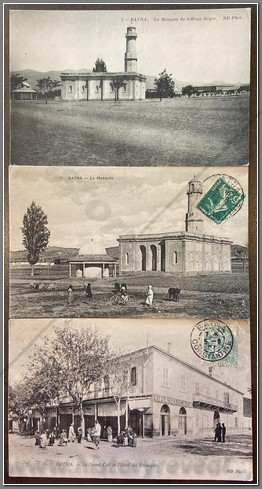
22 colonial postcards of French hotels in Algeria. SOLD

Price: $660.00

tn221TN 221


9 colonial postcards of Algerina types.

Price: $270.00

tn212TN 212


3 postcards written by a gentleman in Souk-Ahras, Algeria to a woman named Eugene.

Price: $180.00

tn211TN 211


6 postcards written by a gentleman in Algeria to a Mademoiselle Hallot in France, between 1912-1927.

Price: $120.00

Copyright © 2013-2024 History Revealed