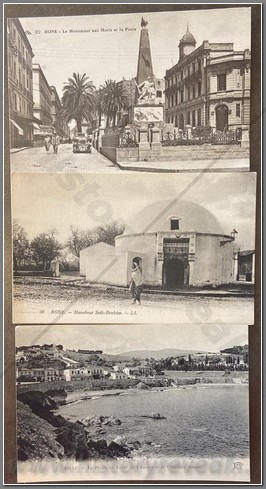
Algeria, Tunisia
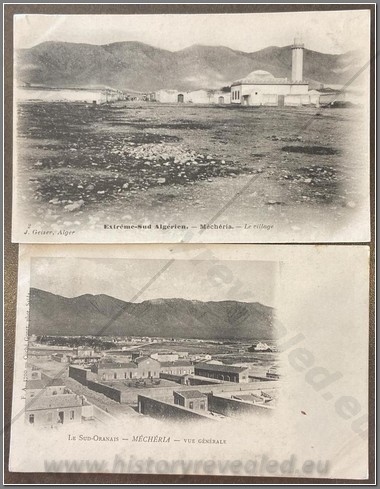
3 colonial postcards of Mecheria (current President of Algeria Abdelmadjid Tebboune was born here in 1945), Marnia (renamed Maghnia) and Mustapha (After independence in 1962, it was given the new name of Si Mustapha, after the nom de guerre of the ALN fighter Mohamed Saoudi, who died nearby in combat on 25 November 1958). Colonial, local arab and architectural interest.
Price: $90.00
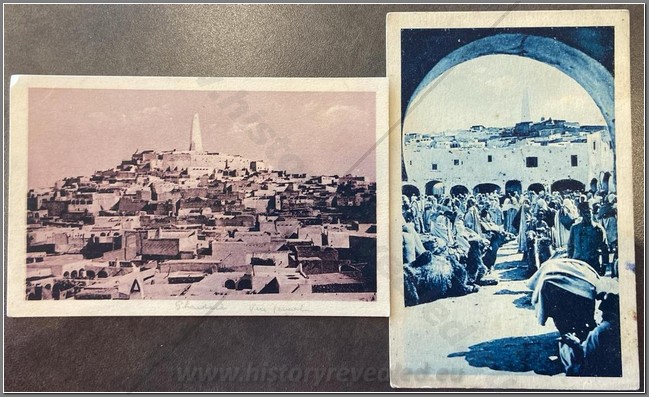
2 colonial postcards of Laghouat. Laghouat was a center of resistance against French colonial rule from 1831 under Sheikh Moussa Ibn Hassen El Misri. In 1852, France launched a punitive campaign to eradicate the resistance. The Siege of Laghouat began on 21 November and concluded with the storming of the town on 4 December. Several days of brutal massacres followed, which included one of the first recorded uses of chemical weapons on civilians. About two-thirds of the population perished, which became known locally as the Khalya (Arabic: emptiness). It also started a local tradition of protecting young boys from evil with an earring (then done to disguise them as girls). Other settlements quickly capitulated following the example set at Laghouat.
Price: $60.00
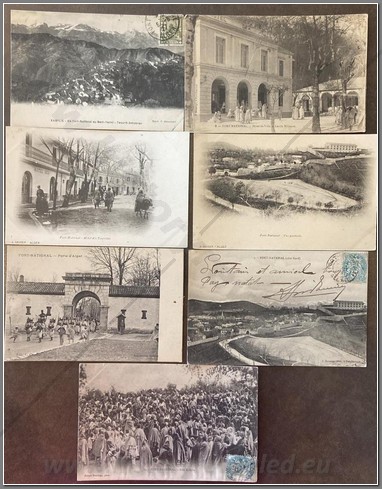
3 colonial postcards of Kouba and Khenchela. Some issued during the Independence war. In 1982, a mass grave containing more than 1200 corpses from the war of Algeria was discovered in Khenchela. It would be the largest ever discovered in Algeria. The authorities and the Algerian press attributed it to the French army, while others disputed this and suggested the victims may have been French harkis.
Price: $90.00
8 early colonial postcards of Philippeville. Mostly architectural. The Battle of Philippeville, also known as the Philippeville massacre or the August Offensive, was a series of raids launched on 20 August 1955 on various cities and towns of the Constantine region by FLN insurgents and armed mobs during the Algerian War between France and the Algerian rebels. The raids, which mostly took the form of ethnic riots, resulted in the massacre of several dozens of European settlers, known as pieds-Noirs. The massacres were then followed by reprisals by the French army and pied-noir vigilantes, which resulted in the death of several thousand Muslim Algerians. The events of late August 1955 in the Constantinois region are considered to be a major turning point of the Algerian War.
Price: $240.00
Colonial postcard of Orleansville (current name is Chlef). On 9 September 1954 an earthquake killed at least 1,243 people and injured 5,000. At that time the town had a population of 44,400 inhabitants. It was the home of the Algerian Division of the artistic group Lettrist International (LI), some of whom died in the earthquake. Mohamed Dahou survived and went on to become involved in the Situationist International. The LI described the town as "the most lettrist city in the world". Issued during the Independence War period.
Price: $30.00