 TN 368
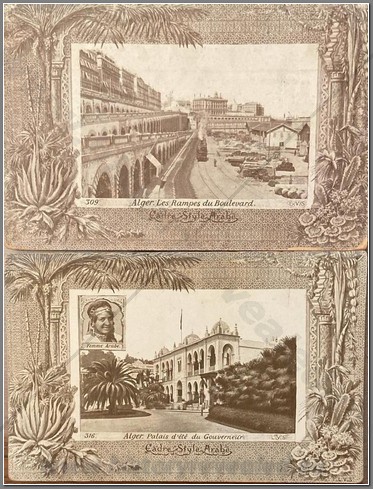
Two picturesque postcards of Alger from the series Cadre Style Arabe.
Price: $60.00

TN 368
Two picturesque postcards of Alger from the series Cadre Style Arabe.
Price: $60.00
 TN 362
 TN 362
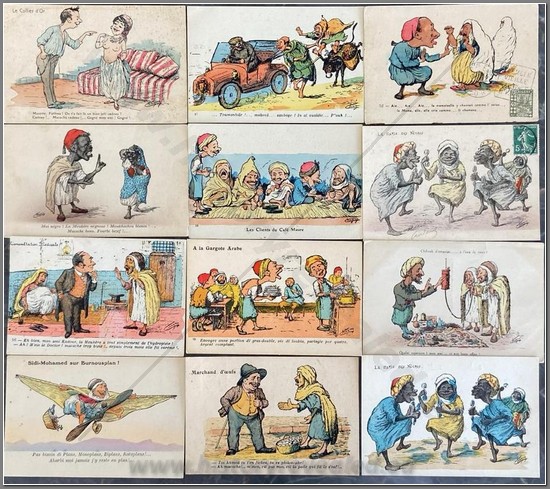
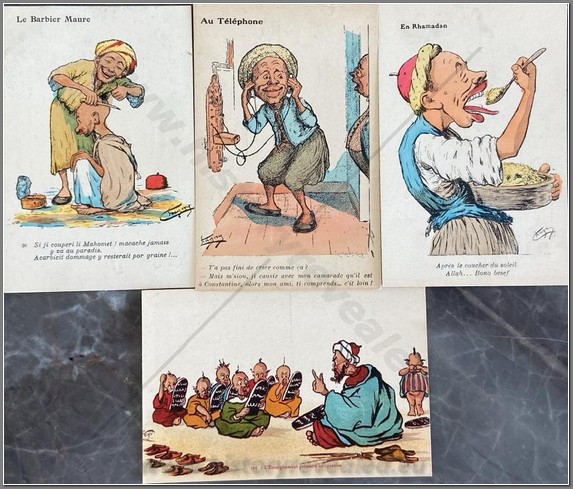
16 satirical colonial postcards of arab life in Algeria, by the artist Chagny. KH SOLD
Price: $480.00
 TN 361
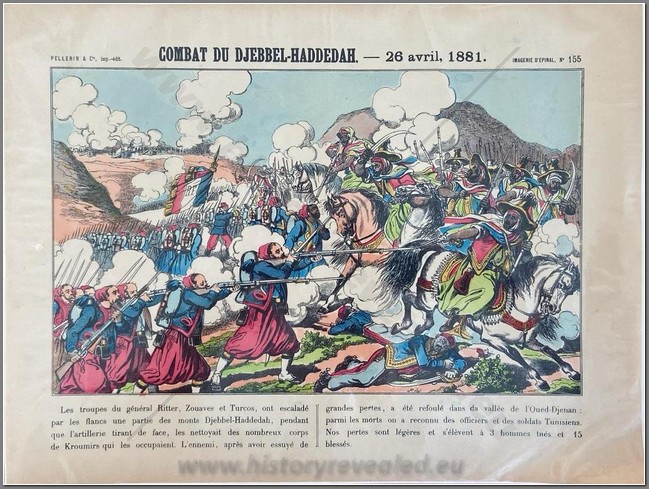
Late 19th century patriotic Pellerin print by Imagerie d’Epinal. It shows the battle of Djebbel-Haddedah, fought in Tunisia April26, 1881. It reads “General Ritter's troops, Zouaves and Turcos, scaled part of the Djebbel-Haddedah mountains from the flanks, while artillery fire from the front cleared them of the numerous Kroumir corps occupying them. The enemy, after suffering heavy losses, was driven back into the Oued-djenan valley; among the dead were Tunisian officers and soldiers. Our losses were light, amounting to 3 men killed and 15 wounded.”
Price: $200.00
NOTE: The Imagerie d'Épinal ( Vosges ) was originally a printing house founded in 1796 by Jean-Charles Pellerin and where the first images of Épinal were engraved in series. Initially a craft, Epinal imagery gradually became a real industry. The imagery initially used an image engraved in a wooden block ( xylography ). The sheet was then printed using a hand press, called a " Gutenberg ". Then the colorist intervened: using stencils, he applied the different colors necessary to finish the work with a round brush. Around 1850 , the appearance of lithography offered greater possibilities to the artist. Nevertheless, the images of Épinal still represented only 2% of the volume of images peddled in 1860. From 1829 to 1845, the imagery celebrated the Emperor Napoleon Bonaparte, his family, his marshals, his armies and his victories. Under the influence of Rousseauist thought, mid- nineteenth - century society began to see children as consumers. Riddles, dolls to assemble, and soldiers entered the catalog of imagery. At the dawn of the 20th century, the production of imagery was known throughout the world. Puppets, paper theatres, constructions and then, during the First World War , military subjects were all areas where dissemination was significant.
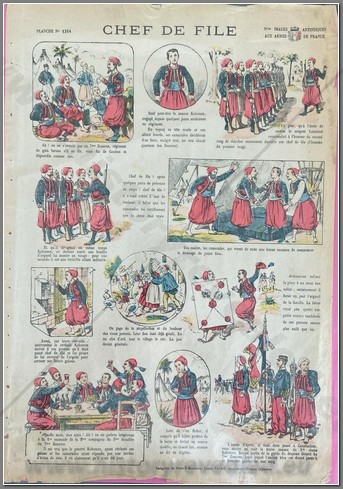 TN 360
Late 19th/early 20th century patriotic Pellerin print by Imagerie D’Epinal. Titled Chef de File, it is about a French zouave named Kelcouen and his life as a zouve. He is transferred to Algeria. The last frame reads: “The following year, if you had been to Constantine, you could have seen the brave Zouave First Class Kelcouen, part of the flag guard of the same decorated Zouaves, for whom the old recruit would have given his last drop of blood.”
Price: $200.00
NOTE: The Imagerie d'Épinal ( Vosges ) was originally a printing house founded in 1796 by Jean-Charles Pellerin and where the first images of Épinal were engraved in series. Initially a craft, Epinal imagery gradually became a real industry. The imagery initially used an image engraved in a wooden block ( xylography ). The sheet was then printed using a hand press, called a " Gutenberg ". Then the colorist intervened: using stencils, he applied the different colors necessary to finish the work with a round brush. Around 1850 , the appearance of lithography offered greater possibilities to the artist. Nevertheless, the images of Épinal still represented only 2% of the volume of images peddled in 1860. From 1829 to 1845, the imagery celebrated the Emperor Napoleon Bonaparte, his family, his marshals, his armies and his victories. Under the influence of Rousseauist thought, mid- nineteenth - century society began to see children as consumers. Riddles, dolls to assemble, and soldiers entered the catalog of imagery. At the dawn of the 20th century, the production of imagery was known throughout the world. Puppets, paper theatres, constructions and then, during the First World War , military subjects were all areas where dissemination was significant.
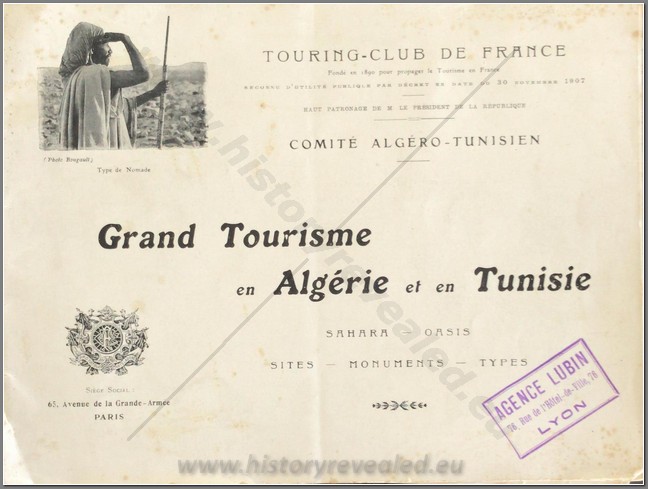 TN 359
Grand Tourisme en Algerie et en Tunisie, by the Touring Club of France, Comite Algero-Tunisien. 40 pages, written in English, French and German.
Price: $90.00
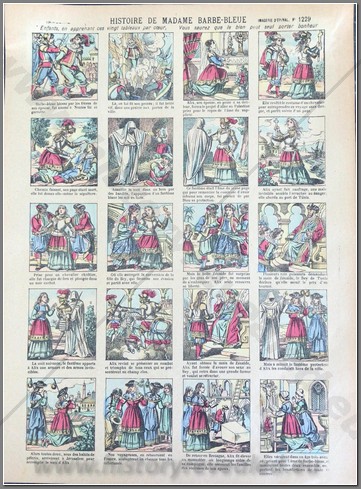 TN 358
Late 19th/early 20th century Pellerin print by Imagerie D’Epinal. Titled Histoire de Madame Barbe-Bleue. It takes place in Tunisia.
Price: $70.00
Note: The Imagerie d'Épinal ( Vosges ) was originally a printing house founded in 1796 by Jean-Charles Pellerin and where the first images of Épinal were engraved in series. Initially a craft, Epinal imagery gradually became a real industry. The imagery initially used an image engraved in a wooden block ( xylography ). The sheet was then printed using a hand press, called a " Gutenberg ". Then the colorist intervened: using stencils, he applied the different colors necessary to finish the work with a round brush. Around 1850 , the appearance of lithography offered greater possibilities to the artist. Nevertheless, the images of Épinal still represented only 2% of the volume of images peddled in 1860. From 1829 to 1845, the imagery celebrated the Emperor Napoleon Bonaparte, his family, his marshals, his armies and his victories. Under the influence of Rousseauist thought, mid- nineteenth - century society began to see children as consumers. Riddles, dolls to assemble, and soldiers entered the catalog of imagery. At the dawn of the 20th century, the production of imagery was known throughout the world. Puppets, paper theatres, constructions and then, during the First World War , military subjects were all areas where dissemination was significant.
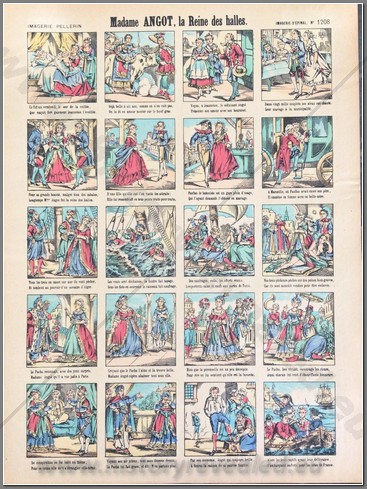 TN 357
Late 19th/early 20th century Pellerin print by Imagerie D’Epinal. Titled Madame Angot, la Reine des Balles. It takes place in Algeria.
Price: $70.00
Note: The Imagerie d'Épinal ( Vosges ) was originally a printing house founded in 1796 by Jean-Charles Pellerin and where the first images of Épinal were engraved in series. Initially a craft, Epinal imagery gradually became a real industry. The imagery initially used an image engraved in a wooden block ( xylography ). The sheet was then printed using a hand press, called a " Gutenberg ". Then the colorist intervened: using stencils, he applied the different colors necessary to finish the work with a round brush. Around 1850 , the appearance of lithography offered greater possibilities to the artist. Nevertheless, the images of Épinal still represented only 2% of the volume of images peddled in 1860. From 1829 to 1845, the imagery celebrated the Emperor Napoleon Bonaparte, his family, his marshals, his armies and his victories. Under the influence of Rousseauist thought, mid- nineteenth - century society began to see children as consumers. Riddles, dolls to assemble, and soldiers entered the catalog of imagery. At the dawn of the 20th century, the production of imagery was known throughout the world. Puppets, paper theatres, constructions and then, during the First World War , military subjects were all areas where dissemination was significant.
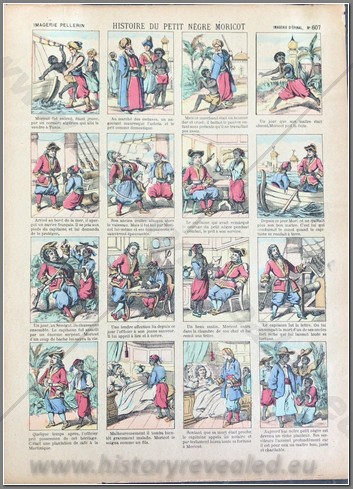 TN 356
Late 19th/early 20th century Pellerin print by Imagerie D’Epinal. Titled Histoire du Petit Negre Moricot. It takes place in Tunisia.
Price: $70.00
Note: The Imagerie d'Épinal ( Vosges ) was originally a printing house founded in 1796 by Jean-Charles Pellerin and where the first images of Épinal were engraved in series. Initially a craft, Epinal imagery gradually became a real industry. The imagery initially used an image engraved in a wooden block ( xylography ). The sheet was then printed using a hand press, called a " Gutenberg ". Then the colorist intervened: using stencils, he applied the different colors necessary to finish the work with a round brush. Around 1850 , the appearance of lithography offered greater possibilities to the artist. Nevertheless, the images of Épinal still represented only 2% of the volume of images peddled in 1860. From 1829 to 1845, the imagery celebrated the Emperor Napoleon Bonaparte, his family, his marshals, his armies and his victories. Under the influence of Rousseauist thought, mid- nineteenth - century society began to see children as consumers. Riddles, dolls to assemble, and soldiers entered the catalog of imagery. At the dawn of the 20th century, the production of imagery was known throughout the world. Puppets, paper theatres, constructions and then, during the First World War , military subjects were all areas where dissemination was significant.
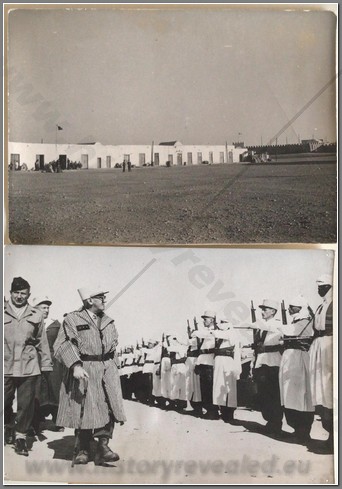 TN 354
2 french military press photos of Tunisia, 1958.
Price: $80.00
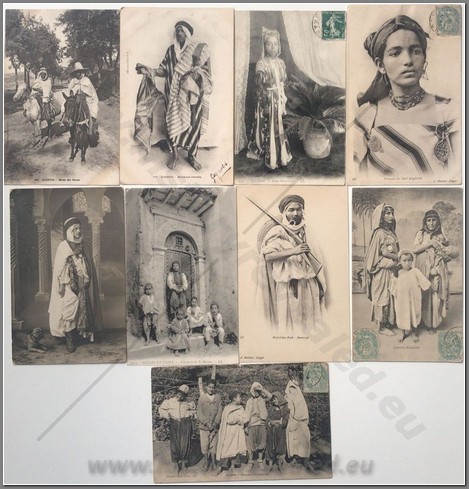 TN 221
12 colonial postcards of Algerina types.
Price: $360.00